

Specifying showers for a 120-room hotel or a multi-location spa chain is never a simple catalog pick. Guests expect steady, scald-safe water temperature at 7 a.m. and 7 p.m., and your local plumbing code expects the same. This 2026 shortlist helps procurement and design teams narrow thermostatic shower system suppliers to the ones built for commercial demand — anti-scald safety, certified valves, and dependable bulk delivery. We start with the shortlisting criteria, walk through a manufacturer evaluation framework, then close with the spec checks that protect your project timeline.
For hospitality, the defining risk is thermal shock. A guest who turns on a shower while a nearby toilet flushes should never get a burst of scalding water. Thermostatic shower systems solve this with a wax- or liquid-filled cartridge that senses inlet temperature and pressure, holding outlet temperature within roughly ±1–2°C even when supply conditions swing. That consistency is why hotel operators and spa groups increasingly specify them as standard rather than an upgrade.
From a maintenance standpoint, thermostatic valves also lower callback rates. A property with 80–200 shower points benefits from fewer “too hot / too cold” complaints and fewer service calls. FAAO has manufactured bathroom hardware since 2001 from its own foundry, machining, polishing, and assembly lines in Wenzhou, China — so the cartridge, trim, and rough-in are controlled under one roof rather than sourced piecemeal from unrelated vendors.

Send us your room count, target certifications (WaterMark, ACS, CE), and preferred finish. FAAO’s engineering team returns a bill of quantities and a lead-time estimate within two business days.
A manufacturer shortlist is only useful if it scores the same dimensions your project will be judged on at commissioning. Below are the six we recommend every hotel and spa specifier weigh before requesting quotes.
| Criterion | Why it matters for hotels & spas | What “good” looks like |
|---|---|---|
| Anti-scald performance | Guest safety and liability exposure | Thermostatic cartridge holds ±1–2°C; meets local scald-prevention rules |
| Certifications | Market access (AU/NZ, EU, NA) | WaterMark (AS/NZS 3718), ACS + CE for EU, relevant local marks |
| Flow rate & pressure | Guest experience and code compliance | Matches building supply (e.g., 0.1–0.5 MPa); G1/2 connections |
| Durability & finish | Lifecycle cost across many rooms | Brass body; PVD/Chrome rated for humid commercial use |
| Lead time & MOQ | Project schedule and cash flow | Confirmed BOQ delivery window; MOQ aligned to room count |
| OEM/ODM & support | Brand consistency and rollout | Custom trim/finish; technical submittal package available |
Rather than naming competitors we cannot vet, use this four-step framework to build your own shortlist and place any supplier — FAAO included — against it:
1. Filter by certification first. If the project is in Australia or New Zealand, the supplier must hold WaterMark to AS/NZS 3718. For France and much of the EU, ACS and CE are the gate. Eliminate any supplier that cannot show the certificate for your target market.
2. Request a submittal package. A serious manufacturer provides drawings, flow/pressure curves, and material specs. FAAO’s engineering team issues these alongside a BOQ so you can compare bids on equal terms.
3. Validate production scale. Ask for factory footage or a virtual audit. A supplier with in-house casting and machining controls lead times far better than a trading company reselling third-party SKUs.
4. Price the full rollout, not the unit. Include rough-in, trim, spare cartridges, and freight. The cheapest headline unit often costs more once the full package lands on site.
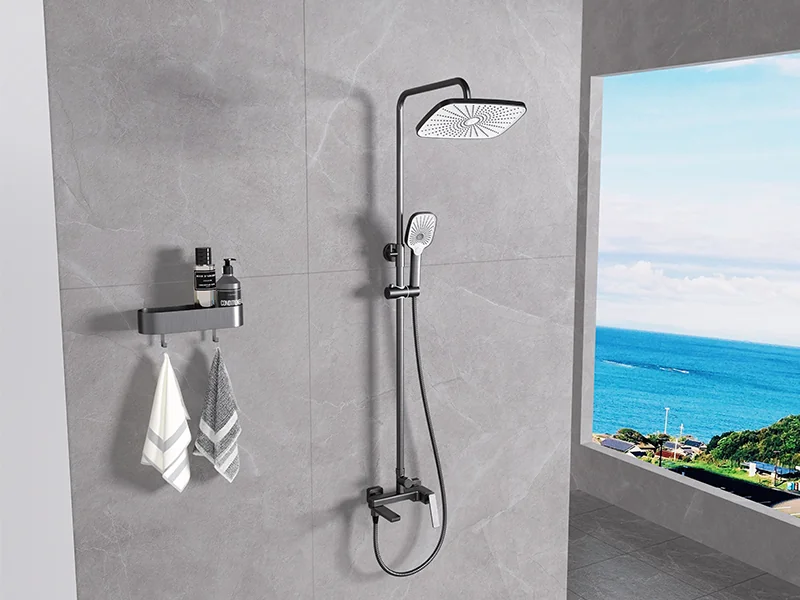
For browsing certified configurations, pair our concealed shower sets for a clean, built-in look in guest rooms, or colonnes de douche for spa and wellness suites.
Get FAAO’s AU/EU-certified shower ranges and the spec sheet that matches your project’s pressure and finish requirements — ready to drop into your bid package.
Certification is the fastest way to shrink a longlist to a shortlist. The market defines the mark:

Because this step trips up even experienced buyers, we built a quick self-check you can run before inviting suppliers to bid. Pair the output with our hotel bathroom shower faucets for AU/EU-certified models, and read our thermostatic shower valve specification guide for the technical detail behind each requirement.

[ ] Target market identified (AU/NZ, EU, NA, or other)
[ ] Required certification confirmed (WaterMark / ACS + CE / UPC)
[ ] Inlet pressure and flow rate documented from building specs
[ ] Anti-scald tolerance (±1–2°C) written into the specification
[ ] Finish and trim standard chosen (Chrome, PVD, Matte Black)
[ ] MOQ and lead time mapped to the project milestone date
[ ] Spare cartridge plan defined for lifecycle maintenance
[ ] Submittal package (drawings + pressure/flow curves) requested
A thermostatic shower uses a temperature-sensing cartridge to hold outlet water within about ±1–2°C even when supply pressure or temperature changes — for example, when a toilet flushes on the same line. Hotels and spas specify them to prevent scalding, cut guest complaints, and lower maintenance callouts across dozens or hundreds of shower points.
It depends on the market: Australia and New Zealand require WaterMark to AS/NZS 3718 (often with WELS rating); France and the EU require ACS for water contact plus CE marking; North America typically needs UPC/cUPC. Always confirm the certificate covers your exact model, not just the supplier’s brand.
Pressure-balancing valves only react to pressure changes and are cheaper, while thermostatic valves also correct temperature swings, giving tighter ±1–2°C control. For hotels and spas where guest safety and consistency are priorities, thermostatic is the stronger commercial choice; pressure-balancing suits budget-sensitive or lower-risk installs.
There is no fixed threshold, but the business case strengthens past roughly 30–50 shower points, where consistent guest experience and reduced callouts outweigh the per-unit premium. Bulk sourcing also unlocks better MOQ terms, matched trim/finish across room types, and a single spare-parts plan.
Certifications for your target market, anti-scald tolerance, material and build quality (brass body, rated finish), confirmed lead time and MOQ, OEM/ODM flexibility, and the availability of a technical submittal package. Price the full rollout — rough-in, trim, spares, freight — not just the headline unit cost.
Tell us the property type, room count, and target market. We will return certified configurations, a BOQ, and a realistic delivery window — so your shortlist is backed by a supplier that can actually deliver.
Specifying showers for a 120-room hotel or a multi-location spa is a sourcing decision, not a styling one. The shortlist that survives commissioning is built on certified valves, documented anti-scald performance, and a supplier whose production scale matches your rollout. Use the criteria and self-check above to filter suppliers quickly, then validate the final two or three with a submittal package and a factory audit. If you want FAAO’s certified shower ranges lined up against your project’s pressure, finish, and certification needs, our team can turn a BOQ and lead-time estimate around within two business days.
 Optimized by Seraphinite Accelerator
 Tél :
Tél :  E-mail:
  French
  English
  Spanish
  Russian
  Portuguese