

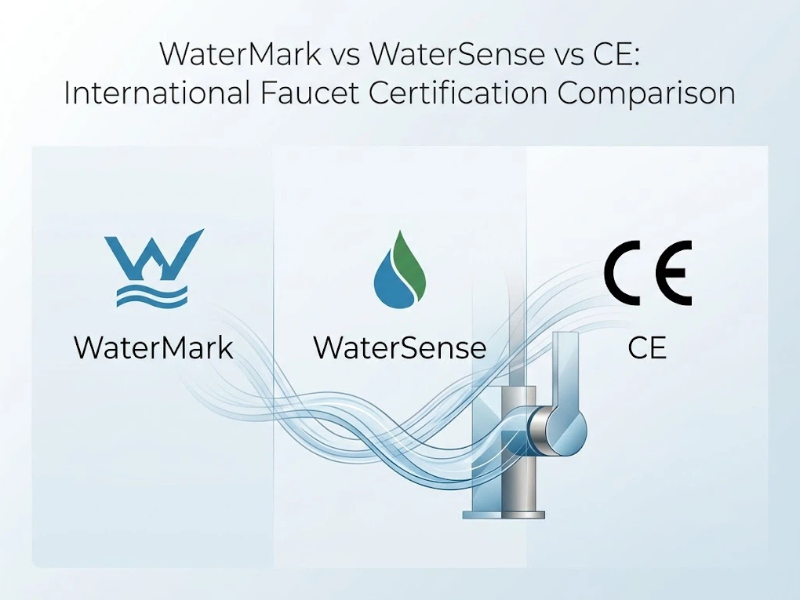
Exporting faucets to international markets means dealing with a web of certification requirements. WaterMark, WaterSense, and CE are among the most widely recognized marks in the sanitaryware industry—but they apply to different regions, test for different performance criteria, and come with very different price tags. Pick the wrong one and you could face customs delays, rejected shipments, or disqualification from project tenders. This comparison guide lays out what each certification covers, how the testing processes differ, and which mark your business actually needs based on where you plan to sell.
WaterMark is a mandatory product certification scheme administered by the Australian Building Codes Board (ABCB). It applies to plumbing and sanitary products sold in Australia and New Zealand, including all types of faucets and tapware. If your product connects to a water supply in these markets, WaterMark certification is not optional—it is a legal requirement under the Plumbing Code of Australia.
The core standard for faucets is AS/NZS 3718, which covers metallic taps, plastic taps, mixing taps, sensor taps, lever taps, and timed flow taps. The standard specifies requirements for materials, flow rates, pressure resistance, temperature performance, durability, and backflow prevention. Products undergo two certification tiers: Level 1 for higher-risk products that require rigorous testing and ongoing factory audits, and Level 2 for lower-risk products with a comparatively streamlined process.
Certification must be obtained through an accredited body such as SAI Global or the WaterMark Certification Agency. Once certified, products are listed in the publicly searchable WaterMark product database, giving specifiers and distributors a way to verify compliance. Manufacturers targeting the Australian market can explore FAAO’s range of WaterMark-certified faucets designed to meet AS/NZS 3718 requirements.
Request WaterMark Faucet Quote
WaterSense is the US Environmental Protection Agency’s voluntary water-efficiency labeling program—think of it as ENERGY STAR, but for water. A WaterSense-labeled bathroom faucet uses at least 30% less water than a standard model, capping flow at 1.5 GPM (gallons per minute) at 60 psi compared to the federal maximum of 2.2 GPM. The program currently covers private lavatory (bathroom sink) faucets and accessories; kitchen faucets and public lavatory faucets are not yet eligible under the V1.0 specification.
Certification involves more than hitting a flow-rate target. Faucets must pass independent third-party testing through an EPA-licensed certifying body such as IAPMO R&T, NSF International, or CSA Group. Testing covers flow-rate performance across multiple pressure ranges (20, 45, 60, and 80 psi), lifecycle endurance (500,000 on/off cycles), and lead-free compliance under NSF/ANSI 372 (weighted average lead content ≤ 0.25%). The testing standard referenced is ASME A112.18.1 / CSA B125.1.
Although WaterSense is technically voluntary, it is effectively mandatory for many commercial projects. LEED-certified buildings, CALGreen requirements, federal procurement rules, and numerous state building codes all reference or require WaterSense-labeled fixtures. For a deeper look at how flow rates affect product specification, read our guide on the standard flow rate of commercial basin faucets.
Explore WaterSense-Compliant Options
CE marking (Conformité Européenne) indicates that a product conforms to health, safety, and environmental protection standards for the European Economic Area. For faucets, CE marking falls under the Construction Products Regulation (CPR) No 305/2011, which requires manufacturers to draw up a Declaration of Performance and affix the CE mark when their products are covered by a harmonised European standard.
Two primary standards govern faucet testing under CE: EN 817 (mechanical mixing valves—general technical specifications) and EN 200 (sanitary tapware—single taps and combination taps for water supply). EN 817 covers single-lever and two-handle mixers, specifying requirements for flow rate, temperature control, mechanical endurance, acoustic performance, and resistance to pressure and temperature fluctuations. EN 200 applies to single-tap configurations.
The European landscape is more fragmented than the US or Australian markets. CE marking alone does not guarantee market access in every EU member state—national drinking water certifications such as ACS (France), WRAS (UK), et DVGW (Germany) are often required on top of CE. Material restrictions on lead, nickel, and cadmium migration are tightening, and the EU has proposed restrictions on certain chrome-plated finishes. Manufacturers planning to supply kitchen faucets or basin mixers to Europe should budget for both CE documentation and at least one national drinking water certification.
The table below summarizes the key differences across all three certifications. Use it as a quick-reference tool when planning your product certification pipeline.
| Criteria | Filigrane | WaterSense | CE |
|---|---|---|---|
| Market | Australia & New Zealand | United States | European Economic Area |
| Governing Body | ABCB (Australian Building Codes Board) | US EPA | European Commission (CPR framework) |
| Key Standard | AS/NZS 3718 | ASME A112.18.1 / CSA B125.1 | EN 817 & EN 200 |
| Flow Rate Limit | Per AS/NZS 3718 (varies by type) | 1.5 GPM max at 60 psi (V1.0) | GPP: 6-8 L/min (voluntary); per EN standard |
| Lead-Free Requirement | Material safety per AS/NZS 4020 | NSF/ANSI 372 (≤ 0.25% lead) | EN 15664 migration limits (lead, nickel, cadmium) |
| Mandatory or Voluntary | Mandatory | Voluntary (effectively required for many projects) | Mandatory under CPR (where harmonised standards apply) |
| Testing Type | Third-party + factory audits | Third-party (EPA-licensed certifier) | Self-declaration or notified body (depending on directive) |
| Typical Timeline | 8-16 weeks | 6-12 weeks | 4-10 weeks (plus national cert if needed) |
| Approximate Cost Range | $3,000 – $8,000 USD per product | $2,000 – $5,000 USD per product | $1,500 – $5,000 USD (varies widely) |
| Certification Validity | 5 years (with annual surveillance) | Ongoing (with annual compliance monitoring) | Valid while product and standards remain unchanged |
Note: Costs and timelines are estimates based on industry averages and vary by product complexity, testing lab, and number of models submitted. Contact your certifying body for project-specific quotes.
Matching the right certification to your sales territory is the single most important planning step. Here is a practical breakdown:
For project-based sales, certification requirements often come from the specifier. Hotel chains, government buildings, and commercial developers publish plumbing schedules that name specific certifications. If you supply faucets for hotel bathroom projects, confirm the required marks before finalizing your product specification.
Discuss Your Target Markets with FAAO
While the three certifications differ in scope, the overall application workflow follows a similar arc. Understanding the common steps helps you parallelize submissions and avoid redundant testing.
Step 1: Document Preparation. Compile technical files including product drawings, material declarations, BOM (bill of materials), and manufacturing process flow. For WaterSense, you must also sign an EPA partnership agreement before testing begins.
Step 2: Sample Submission. Send production-grade samples to the accredited lab. WaterMark and WaterSense require samples from actual production runs—not prototypes—to ensure consistency. CE testing may use representative samples if self-declaration is permitted.
Step 3: Laboratory Testing. Labs run the full battery of tests: flow rate, pressure resistance, temperature cycling, mechanical endurance, acoustic performance (CE/EN), and material extraction. WaterSense testing also verifies lifecycle performance through 500,000 on/off cycles.
Step 4: Factory Audit (if applicable). WaterMark Level 1 requires an initial factory audit and annual surveillance audits. WaterSense certifiers conduct periodic facility reviews. CE self-declaration does not require audits, but notified-body CE routes may.
Step 5: Certification and Listing. Once testing and audits pass, the certifying body issues the certificate and lists the product in the relevant public database (WaterMark product search, EPA WaterSense directory, or EU Declaration of Performance register).
Certification budgets depend on three factors: the number of product models, the complexity of testing, and whether factory audits are required. A single basin faucet typically costs $2,000-$8,000 USD to certify, depending on the mark. Adding variants (different finishes, spout lengths) can sometimes piggyback on the same certification if the internal components are identical—ask your lab about “family” certification options.
Timelines range from 4 weeks (CE self-declaration with existing test data) to 16 weeks (WaterMark Level 1 with factory audit). Plan for retesting if your product undergoes any design change after certification, as even minor modifications to the cartridge or aerator can invalidate a certificate. Manufacturers working with experienced faucet suppliers can often leverage existing test reports to reduce both time and cost.
WaterMark certification is legally mandatory for all plumbing products, including faucets, sold in Australia and New Zealand. The certification is administered under the Plumbing Code of Australia and requires compliance with AS/NZS 3718. Products without WaterMark certification cannot be legally installed by licensed plumbers in these markets. You will also need a WELS (Water Efficiency Labelling and Standards) water-rating label.
No. WaterSense is a voluntary EPA labeling program. However, many state building codes, federal procurement contracts, LEED-certified projects, and utility rebate programs require or incentivize WaterSense-labeled fixtures. For commercial and multi-family residential projects, it is effectively mandatory in practice. A faucet that meets the 1.5 GPM flow rate without the actual WaterSense label does not qualify—only products tested and certified by an EPA-licensed body can carry the label.
Yes, but the certifications test for different things and require separate applications. A faucet can be designed to meet both AS/NZS 3718 and EN 817 standards, then submitted to separate certifying bodies for each mark. Many global manufacturers pursue dual or triple certification to serve multiple markets from a single product platform. The key is to design the product upfront to satisfy the strictest requirements across all target standards.
Testing timelines vary by certification: WaterSense typically takes 6-12 weeks, WaterMark takes 8-16 weeks (longer if a factory audit is required), and CE marking takes 4-10 weeks depending on whether you use self-declaration or a notified body. These estimates assume the product passes on the first attempt. Failed tests can add 4-8 weeks for redesign and retesting. Start the certification process at least 4-6 months before your planned market launch.
WaterMark is generally the most expensive at $3,000-$8,000 USD per product due to factory audit requirements and the two-tier system. WaterSense costs $2,000-$5,000 USD per product, covering third-party testing and EPA partnership fees. CE is typically the least expensive at $1,500-$5,000 USD if self-declaration is possible, but costs rise significantly if a notified body is required or if you add national drinking water certifications like ACS or WRAS. Family certification (grouping similar models) can reduce per-unit costs by 30-50%.
WaterMark, WaterSense, and CE each unlock access to a specific market, but none of them substitute for another. Your certification roadmap should mirror your sales territory: WaterMark for Australia and New Zealand, WaterSense for US water-efficiency compliance, and CE for the European Economic Area. For manufacturers pursuing multi-region distribution, front-loading your testing strategy prevents costly rework and shipping delays. FAAO supports B2B partners with pre-certified faucet lines and full OEM/ODM documentation. Tell us your target markets, and our team will help you assemble a compliant, certification-ready product portfolio.
 Optimized by Seraphinite Accelerator
 Tél :
Tél :  E-mail:
  French
  English
  Spanish
  Russian
  Portuguese