

If you’ve ever sourced faucets from China — or you’re about to — you’ve probably run into the same fork in the road that every importer, distributor, and brand owner faces: OEM or ODM?
This decision shapes your product quality, your brand identity, your upfront investment, and frankly, how much sleep you get during the first production run. Here’s what nobody tells you upfront: there is no universally “better” model. The right answer depends entirely on what kind of business you’re building.
FAAO has been manufacturing faucets since 2001. Over 25 years, we’ve shipped half a million units annually to more than 80 countries — everything from fully custom OEM projects for Fortune 500 suppliers to ready-to-brand ODM collections for fast-growing e-commerce sellers. We’ve seen both models succeed and both models fail, usually for the same reason: the buyer picked the wrong one for their stage of growth.
This guide will walk you through the real differences between OEM and ODM faucet manufacturing, give you a practical framework for choosing, and flag the hidden costs that trip up first-time buyers. No fluff, no theory — just what we’ve learned from the factory floor.
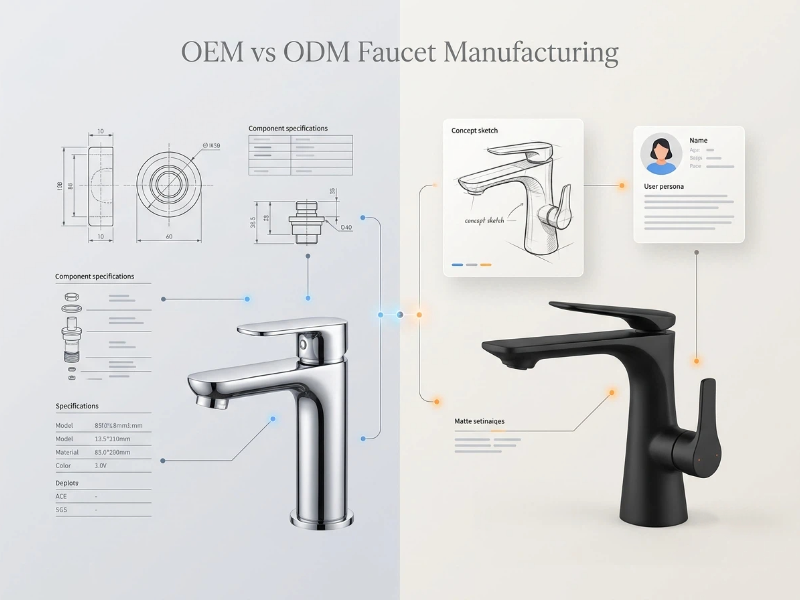
Socle stands for Original Equipment Manufacturing. In the faucet industry, it means you — the buyer — provide the design, the specifications, and the quality requirements. The factory executes. Period.
You own the mold. You own the design files. You own the intellectual property. The factory’s job is to pour the brass, machine the components, polish the surfaces, assemble the parts, and package the finished product — all to your spec, not theirs.
Think of it like this: you’re the architect, the factory is the construction crew. You bring the blueprint; they bring the equipment and the labor.
OEM is your best bet when you have a clear design vision, a defined target market, and the budget to invest in tooling. It’s the default model for established brands that compete on differentiation — not just price. If your customers can buy the same faucet from three other Amazon sellers, you’re not building a brand; you’re running an arbitrage business. OEM is how you build something nobody else can sell.
ODM stands for Original Design Manufacturing. Here, the factory does the heavy lifting on R&D. They’ve already designed the faucet, built the mold, tested the prototypes, and ironed out the production kinks. Your job is to pick the design, add your branding, and start selling.
You’re essentially licensing the factory’s existing design. The mold already exists. The production line is already dialed in. You’re not starting from zero — you’re starting from “done.”
You’re the brand owner, not the designer. The factory handles the engineering; you handle the branding, marketing, and distribution.
ODM is ideal for e-commerce sellers, new brands testing the market, and distributors who need to move fast. If your competitive advantage is your marketing engine, your distribution network, or your brand positioning — not your product engineering — ODM gives you a quality product without the R&D headache. Plenty of seven-figure Amazon businesses are built entirely on ODM faucets from a trusted faucet OEM manufacturer-turned-supplier.
Let’s put the two models side by side. If you’re in the trenches evaluating suppliers, this is the table you’ll want to come back to.
| Dimension | OEM (Original Equipment Manufacturing) | ODM (Original Design Manufacturing) |
|---|---|---|
| Design Ownership | Buyer owns the design and mold | Factory owns the design; buyer licenses it |
| Mold Cost | $3,000–$15,000 per design (buyer pays) | $0 (mold already exists) |
| Quantité minimale de commande | 500–1,000 units per SKU | 100–300 units per SKU |
| Lead Time | 60–120 days (including mold development) | 20–45 days |
| Customization Depth | Full — geometry, internals, finish, packaging | Surface-level — finish, handle, branding, packaging |
| Per-Unit Cost | Lower at scale (amortized mold cost) | Higher per unit (mold cost built into price) |
| Market Exclusivity | Full — your design, your market | None — same design may appear under other brands |
| Mieux pour | Established brands, unique product lines, hardware chains | E-commerce sellers, new brands, market testing, distributors |
We use this framework at FAAO when a new client comes to us unsure about which path to take. It’s not complicated, but it’s clarifying.
If you’ve got CAD files, mood boards, and a very specific look in mind, you’re in OEM territory. If you’d rather browse a catalog and pick what performs, ODM is your lane. Be honest here — half the buyers who come in saying “I want something unique” actually mean “I want something that looks unique to my customers, but I don’t want to pay for a mold.” That’s fine. Just know what you’re really buying.
A single OEM faucet mold for a kitchen faucet with a pull-down sprayer runs $5,000-$8,000. A complete bathroom faucet collection with basin, shower, and tub variants can easily hit $20,000-$40,000 in tooling alone. If that number makes you wince, start with ODM and reinvest profits into OEM later. Plenty of our long-term clients did exactly that — they launched with ODM bathroom faucets, built cash flow, then commissioned custom OEM kitchen faucets once the business was stable.
If you’ve got a trade show in 60 days and need samples, ODM is your only realistic option. OEM mold development alone takes 25-40 days before you even see a prototype. We’ve rushed OEM projects before — and it almost always costs more in rework than it saves in time. Rushing a mold leads to flashing issues, poor surface finish, and dimensional drift. Don’t do it.
This one catches people off guard, but it matters. OEM molds are assets. If you ever sell your brand, those molds transfer to the buyer — and they’re worth something on the balance sheet. ODM products? You’re selling inventory and brand equity, not IP. Both exit strategies work. Just know which one you’re building toward.
If you’re selling in Western Europe or North America through hardware chains like Bunnings or Metro — both of which FAAO supplies — the bar for differentiation is higher. Buyers at that level can spot a catalog faucet from across the room. OEM gives you the differentiation you need to win shelf space. If you’re selling direct-to-consumer online, a well-curated ODM line with strong branding can absolutely compete — especially when you nail the packaging and the listing content.
Both models have their gotchas. Here’s what we’ve seen trip up buyers over the years.
We built FAAO to handle both paths under one roof — and we’ve been doing it since 2001. Our 20,000-square-meter factory in Wenzhou runs parallel production workflows: a dedicated OEM line for custom projects and a flexible ODM line for catalog-based orders. Here’s what each looks like in practice.
When you come to us with a design — whether it’s a fully engineered CAD file or a napkin sketch — our engineering team handles the DFM (Design for Manufacturing) review, prototyping, mold development, and pilot production. We’ve produced OEM robinets de lavabo, shower faucets, et robinets de baignoire for brands sold in Bunnings, Metro, and other major hardware chains. Over 200 patents and counting — we know how to protect your IP.
Our ODM catalog spans hundreds of designs across every faucet category — kitchen, basin, shower, bathtub, concealed sets, and shower columns. Every design has been through full production validation, quality testing, and multiple revision cycles. You pick the design, choose your finish and packaging, and we deliver. It’s how e-commerce sellers on Amazon and regional distributors go from order to listing in under 45 days.
The hybrid approach: One thing we see more of lately: brands that start with ODM for their core line and commission OEM for a hero product. It’s a smart capital allocation strategy — ODM covers the volume, OEM builds the brand halo. If that sounds like where you’re headed, we’d be happy to talk through what a hybrid roadmap looks like for your category.
Yes — and it’s actually a common growth path. Many of FAAO’s long-term clients started with ODM catalog products to test the market, then transitioned to OEM once they had validated demand and built up capital for tooling. The key advantage of staying with the same factory is continuity: the quality standards, communication cadence, and logistics are already established. The transition itself usually takes 60-90 days because you’re starting OEM mold development from scratch — the ODM molds belong to the factory and can’t be retrofitted into your designs.
At minimum, look for ISO 9001 (quality management system). For faucets specifically, the certifications depend on your target market: ACS for France, WRAS for the UK, WaterMark for Australia, cUPC for North America, and CE for the EU. FAAO holds ISO 9001, CE, ACS, and WaterMark — and we can produce to cUPC and WRAS standards on request. Don’t take a factory’s word for it; ask to see the actual certificates with expiration dates. A legitimate factory will send them without hesitation.
The honest answer: it depends heavily on complexity, materials, and finish. A basic single-handle basin faucet in chrome with a standard ceramic cartridge might run $15-$25 per unit at OEM volumes (1,000+ units), plus $3,000-$5,000 for the mold. A premium kitchen faucet with a pull-down sprayer, magnetic docking, and PVD finish can easily hit $40-$70 per unit with a $6,000-$10,000 mold. The brass material grade (standard vs. lead-free), cartridge brand (generic vs. Kerox/Sedal), and finish type (chrome vs. PVD vs. electroplated matte black) are the three biggest cost drivers. Request a detailed BOM (bill of materials) from your supplier — it should break down the cost of every component.
Not exactly, though the terms get used interchangeably in the industry. Private label is a subset of ODM: you take an existing factory design, add your logo and packaging, and sell it under your brand. But ODM can also include minor modifications — changing the handle style, swapping the aerator, or selecting a different cartridge grade — that go beyond pure re-labeling. When you’re talking to suppliers, be specific about what level of modification you need. Saying “I want private label” when you actually need a modified cartridge or a custom PVD finish will lead to mismatched expectations on both sides.
For OEM custom faucet manufacturing, most factories set MOQs at 500-1,000 units per SKU. The mold cost is the real gatekeeper — the factory needs volume to justify the line setup time. For ODM, MOQs are more flexible: 100-300 units is common, and some suppliers (including FAAO’s e-commerce service) accept 50-unit trial orders for catalog designs. If you need ultra-low MOQs — say 20-50 units — look for factories that explicitly offer small-batch or “sample-plus” programs. But expect to pay a 30-50% premium on per-unit pricing at those volumes. The factory still needs to cover its setup costs.
Whether you go OEM or ODM, the factory matters more than the model. Here’s our quick-and-dirty factory vetting checklist, drawn from 25 years on the manufacturing side:
Whether you need a fully custom OEM faucet line built from your design files, or you want to launch quickly with a proven ODM collection, FAAO has the factory floor, the engineering team, and the 25-year track record to deliver. Let’s talk about your project.
Get a Free Quote — Tell Us About Your Project
No commitment required. Response within 24 hours.
There’s no universal right answer between OEM and ODM faucet manufacturing. The right model is the one that matches your stage, your budget, and your long-term ambition.
OEM is for brand builders. It’s more expensive upfront, takes longer, and demands more from you as a buyer — but it gives you a product no one else can sell, lower unit costs at scale, and an asset (the mold) that holds real value.
ODM is for speed and capital efficiency. You sacrifice exclusivity and deep customization, but you get to market in weeks instead of months, with zero tooling investment and proven product reliability. For e-commerce sellers, distributors, and market testers, it’s often the smarter starting point.
And if you’re somewhere in between? That’s where the hybrid approach shines — and where a factory with both capabilities under one roof becomes a genuine strategic partner, not just a supplier.
Got questions about which model fits your business? Reach out. After 25 years and 80+ countries, we’ve probably seen a situation similar to yours — and we’re happy to share what we’ve learned.
 Optimized by Seraphinite Accelerator
 Tél :
Tél :  E-mail:
  French
  English
  Spanish
  Russian
  Portuguese