

New Zealand’s tapware market runs on a clear rule: faucets must meet recognised standards before they reach a building site. Since October 2025, that rule has a new shortcut — WaterMark-certified products are now formally accepted as compliant with the New Zealand Building Code. For importers, specifiers, and OEM buyers, this reshapes how you source faucets for NZ projects. This guide breaks down the standards, the certification path, and what your documentation needs to look like to clear consent without hold-ups.
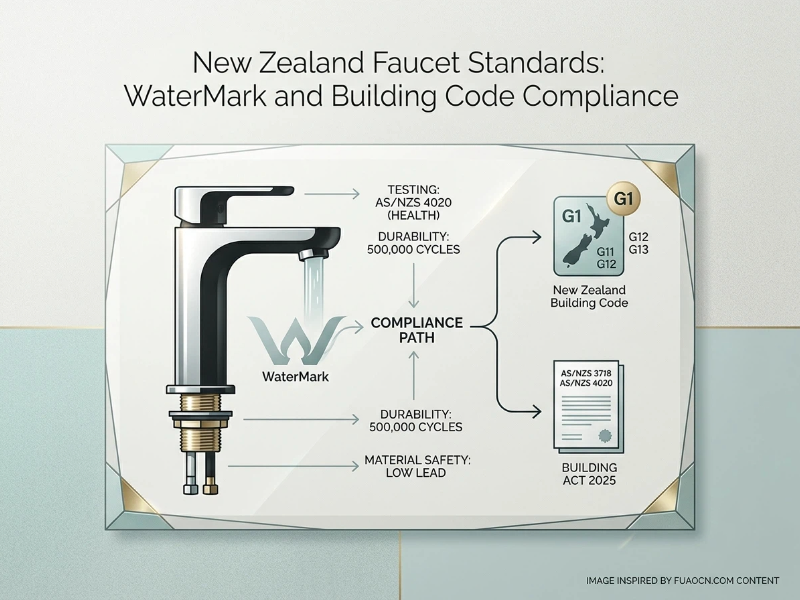
New Zealand doesn’t run a standalone domestic certification scheme for faucets. Instead it leans on a mix of the New Zealand Building Code (NZBC) and referenced joint Australian/New Zealand standards. The practical result: a faucet destined for a NZ installation has to satisfy the performance requirements of NZBC — most directly Clause G12 Water Supplies — and the accepted way to demonstrate that satisfaction is product certification against the relevant Australian standard.
The standard governing taps and mixing valves is AS 3718:2021, which superseded AS/NZS 3718:2005. It sets out material, performance, and testing requirements for metallic, plastic, mixing, sensor, lever, and timed-flow taps in nominal sizes from DN 6 to DN 50. Installation rules sit in the AS/NZS 3500 plumbing and drainage series, and materials in contact with drinking water are assessed against AS/NZS 4020.
Until recently, a faucet certified under Australia’s WaterMark scheme sat in a grey area here — the certification was widely respected, but not formally codified as an Acceptable Solution. That changed with the 2025 recognition notice, which applies across the board to robinets de lavabo, kitchen faucets, shower faucets, et robinets de baignoire alike.
WaterMark is the mandatory third-party certification scheme for plumbing and drainage products in Australia, administered by the Australian Building Codes Board (ABCB). A faucet bearing the WaterMark mark has been type-tested to the applicable standard, the factory has been audited, and the product is listed in the publicly searchable WaterMark Product Database.
The certification process, in practical terms, runs like this:
If you are working out how to get WaterMark certification for faucets for the first time, the single biggest time-sink is usually the type-test round — a product that fails sealing or endurance has to be re-engineered and retested before the licence can move forward.
Source WaterMark-Certified Faucets for Your NZ Projects
FAAO holds active WaterMark certification across its faucet range. Send your NZ project spec — basin, kitchen, shower, or bath — and receive compliant models with licence numbers ready for consent documentation.
On 1 October 2025, MBIE published the Building (Product Recognition WaterMark Tapware) Notice 2025, recorded as recognition notice RN-10009. Under the Approved Products Certified Overseas pathway, it formally recognises WaterMark-certified tapware, tap accessories, and showers as compliant with specified clauses of the NZBC.
What this covers:
The notice applies to roughly 92,500 WaterMark-certified tapware products already in the database. From the effective date, Building Consent Authorities (BCAs) must accept products covered by the notice as Building Code compliant, provided they are used within the conditions and limitations stated on the certificate. That includes concealed shower sets et robinets d'eau froide whose certificates fall inside the DN 6–50 scope.
Clause G12 (Water Supplies) is the Building Code provision most directly governing faucets. It requires buildings with water outlets to have safe and adequate water supplies, and it sets out requirements to prevent scalding, injury, leaks, contamination of potable water, illness, and legionella growth. A compliant faucet contributes to G12 by controlling flow, mixing temperature safely, and not leaching contaminants into drinking water — these are the NZ Building Code G12 tapware requirements that importers get asked about most.
Before the 2025 notice, importers typically demonstrated G12 compliance through an Alternative Solution approval — a slower, case-by-case route. WaterMark products can now be presented as an Acceptable-Solution-equivalent pathway, which streamlines consent. Two other clauses often come into play: B2 Durability (faucets must perform for their stated service life) and E3 Internal Moisture (relevant where tapware interfaces with wet-area waterproofing).
Not Sure If Your Spec Clears G12?
Our team maps FAAO WaterMark-certified models to NZBC G12, B2, and E3 requirements so your consent pack is complete the first time. Share your drawings and we will match compliant products.
Understanding the test scope helps B2B buyers judge whether a supplier’s claims are real. Under AS 3718:2021, a faucet is pushed through:
A product that clears all of this carries genuine weight — it is not a paperwork exercise. When a supplier quotes WaterMark certified faucet suppliers as a credential, ask for the licence number and confirm it in the database before you treat the claim as load-bearing.
Use this before you commit to a purchase order or specify a product in a NZ project. Tick each line against the supplier’s certificate and the recognition notice.
NZ Faucet Compliance Checklist
☐ WaterMark licence number verified in the ABCB database (status: Active)
☐ Product scope on the certificate matches your intended use
☐ AS 3718:2021 listed as the specification (not the withdrawn AS/NZS 3718:2005)
☐ Size (DN 6–50) and temperature rating (≤80°C) within RN-10009 scope
☐ Certificate and recognition notice copy ready for the consent application
☐ Installation instructions that match AS/NZS 3500 requirements
☐ Factory surveillance audit current (not expired)
Anyone can check a WaterMark claim in minutes:
If a supplier can’t produce a licence number, or the database shows the product as Suspended or Cancelled, treat it as non-compliant for NZ consent purposes. The licence number is a six-digit code found alongside the WaterMark symbol on the product or its packaging — if you only have a four-digit number, pad it with leading zeros (for example, 1234 becomes 001234).
Need a Faucet Partner Who Ships with Paperwork Ready?
FAAO supplies OEM and ODM buyers with active WaterMark licences, AS 3718:2021 test reports, and recognition-notice documentation bundled with every shipment — built for the NZ consent process.
WaterMark is an Australian scheme, so it is not legally mandatory inside New Zealand on its own. But since the October 2025 recognition notice (RN-10009), WaterMark certification is the most direct accepted pathway to demonstrate NZBC compliance for tapware. Without it, importers typically need an Alternative Solution approval — slower and costlier. In practice, B2B buyers who treat WaterMark as the default move fastest through consent.
Clause G12 (Water Supplies) is the primary clause — it governs safe water delivery, scalding prevention, and contamination control. Clause B2 (Durability) applies to service life, and E3 (Internal Moisture) is relevant where tapware interfaces with wet-area waterproofing. The recognition notice RN-10009 ties WaterMark certification to these clauses.
AS 3718:2021 is the current Australian standard for tapware and has superseded the older joint standard AS/NZS 3718:2005. The 2021 version is what the WaterMark scheme and the NZ recognition notice reference. Products still certified to the withdrawn 2005 edition should be checked against current certificates before being specified.
Typical timelines run 8 to 16 weeks from application to licence issue, depending on how ready the technical file is, laboratory scheduling for type testing, and factory audit availability. Products that fail a test round add 4 to 6 weeks per retest. Budget for surveillance audits annually or biennially to keep the licence active.
Search the WaterMark Product Database at watermark.abcb.gov.au by licence number, brand, or model. Confirm the status reads Active, the specification field lists AS 3718:2021, and the scope matches your intended use. Download or screenshot the certificate for your consent documentation.
Explore FAAO’s WaterMark-certified faucet range and supporting product lines for NZ-compliant specifications:
New Zealand’s faucet compliance landscape has genuinely simplified since October 2025 — WaterMark is now a recognised, not just respected, route to Building Code compliance. For B2B buyers, the work shifts from fighting case-by-case Alternative Solutions to verifying certificates and matching product scope. Get the licence number, confirm it is active, and make sure the certificate covers your exact application. That is the difference between a consent that sails through and one that stalls. FAAO’s WaterMark-certified faucet range is built around exactly this pathway — talk to our team about your NZ project specs.
 Optimized by Seraphinite Accelerator
 Tél :
Tél :  E-mail:
  French
  English
  Spanish
  Russian
  Portuguese