

Factory audits are the difference between a reliable bathroom faucet supplier and a costly sourcing mistake. Whether you import for retail, hospitality, or plumbing wholesale, walking into a Chinese factory with a structured checklist protects your brand, your budget, and your delivery timeline. This guide gives you a practical B2B audit framework you can use on your next visit, during a video audit, or when briefing a third-party inspector. You will learn the eight inspection points that matter most, from legal standing and production lines to testing labs and red flags.
Too many buyers treat a factory tour as a marketing event. They see a clean showroom, drink tea in the meeting room, and leave with a price list. The real risks hide where guests are not taken: the foundry floor at midnight, the plating shop effluent, the QC station that only exists on paper.
A strong audit is evidence-based. It checks documents, observes live production, interviews operators, and cross-checks certificates. The goal is not to be impressed; the goal is to confirm the factory can consistently make bathroom faucets that meet your specification and market regulations.
Source from a Factory That Opens the Floor to You
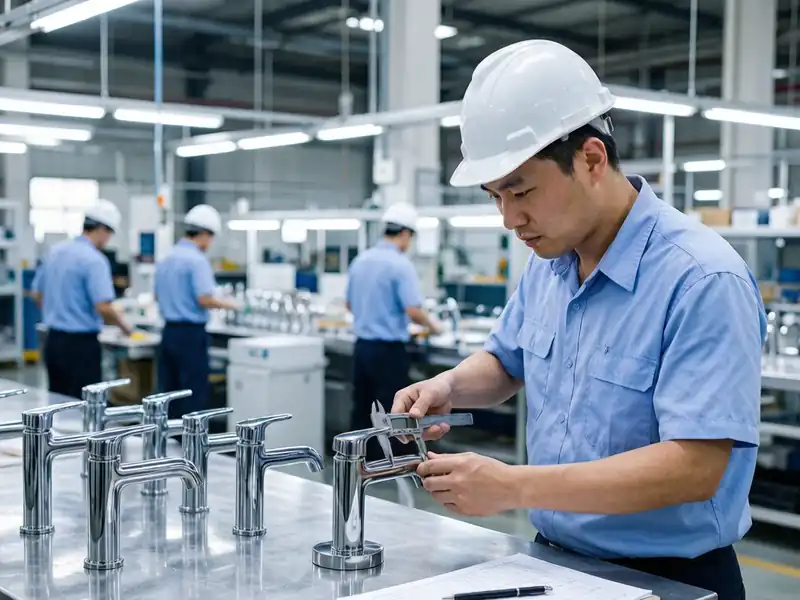
FAAO runs in-house foundry, machining, polishing and assembly lines, and welcomes customer audits and third-party inspections.
Start with the basics. Request the business license and check that the registered address matches the factory you are visiting. Look at the registered capital and scope of business; if it only mentions trading, the facility is unlikely to be a true manufacturer. Verify ISO 9001 validity through the issuing body and make sure the certificate covers faucet or sanitary ware production, not just general hardware.
A real faucet factory controls the full flow: brass casting or forging, CNC machining, polishing, electroplating or PVD, cartridge and aerator assembly, and final packing. Ask to see each step in operation. If the guide refuses to show the plating shop or says it is “off-site,” treat that as a yellow flag.
Check machine age and maintenance logs. Ask how many shifts run per day and what their typical monthly output is for robinets de lavabo. Capacity should comfortably exceed your forecast by at least 30% to avoid lead-time squeezes during peak season.

Need Basin Faucets Built to Your Spec?
Browse FAAO basin faucet range with customizable finishes, handles and cartridges for hotel, retail and project channels.
ISO 9001 on the wall means little without daily practice. Ask to see incoming material inspection records for brass ingots and zinc alloy castings. Look for in-process checkpoints at machining, polishing and assembly, and confirm how final inspection samples are selected. A mature factory uses AQL 2.5 or similar sampling plans and can show you recent inspection reports.
Bathroom faucets sold in most markets need more than a visual check. Ask to see the pressure test bench, the salt-spray chamber for corrosion resistance, and the flow-rate measuring rig. For regulated markets, confirm certificates like WaterMark for Australia, CE for Europe, ACS for France or NSF for North America are current, correctly labeled and traceable to the factory.
Cross-check certificate numbers on the official database of the certification body. Older factories may display expired certificates or certificates that belong to a trading partner rather than the production site.

European and North American retailers increasingly require BSCI, Sedex or SA8000 evidence. Even without a formal audit program, walk the workshops, check fire exits, and observe worker age and safety equipment. Ask how electroplating waste water is treated; illegal discharge is both a compliance and a supply disruption risk.
B2B buyers rarely need off-the-shelf products. Ask for examples of OEM projects the factory has completed: 3D drawings, prototype lead times, mold ownership terms, and surface finish options. A strong manufacturer will have an in-house R&D team, a sample room with physical references, and clear engineering feedback loops. If you need guidance on the partnership model, read our comparison of OEM vs ODM faucet manufacturing.
Technical problems will arise. The question is how fast and clearly the factory responds. Test them before the audit: send a drawing or finish question and measure response time. During the visit, ask who will manage your account, how often production updates are shared, and what happens when a defect batch is discovered.
Tick the boxes that describe the factory you are auditing. The scorecard weights the items based on how strongly they predict supplier reliability. Total possible score: 96.
| Checkpoint | Poids | Pass |
|---|---|---|
| Legal & Business Standing | ||
| 5 | ||
| 5 | ||
| 4 | ||
| Production Capability | ||
| 8 | ||
| 6 | ||
| 6 | ||
| Quality Management | ||
| 6 | ||
| 6 | ||
| 4 | ||
| Testing & Certifications | ||
| 7 | ||
| 7 | ||
| 5 | ||
| Compliance & Sustainability | ||
| 4 | ||
| 4 | ||
| Service & Communication | ||
| 5 | ||
| 5 | ||
| 4 | ||
Audit Score: 0 / 96
Start ticking items to see your verdict.
Arrive unannounced if possible, or at least keep the schedule flexible. Begin in the document room, move through raw material storage, machining, polishing, plating, assembly, testing and packing. Take photos of equipment nameplates, certificate copies, and production boards. End with a closing meeting where you list open findings and request a corrective action plan with dates.
If you cannot travel, hire a local third-party inspector from SGS, TÜV, Intertek or Bureau Veritas. A half-day factory audit typically costs $300–$800, which is small compared to the cost of a rejected container.
Plan Your Audit with FAAO
FAAO has been a sanitary ware manufacturer since 2001, with 500+ professionals and exports to 80+ countries. Book a factory tour or video audit today.
Request the business license, ISO 9001 certificate, export license, product certificates for your target market (WaterMark, CE, ACS, NSF), and recent third-party test reports. Also ask for a production process flow chart and a sample quality control checklist.
Check the business scope on the license, look for in-house foundry or forging equipment, CNC machines, polishing lines and assembly stations. A trading company usually rents office space, shows mixed unrelated products, and is reluctant to let you walk the production floor freely.
The required certification depends on your market. WaterMark is mandatory for Australia and New Zealand, WELS covers water efficiency in Australia, CE is needed for the EU, ACS for France, and NSF/ANSI 61 for North American drinking water contact. Our faucet certification comparison explains the differences.
A standard one-day factory audit in a faucet manufacturing hub such as Zhejiang or Guangdong generally costs between $300 and $800, depending on the auditing body, scope and travel distance. For first orders, the cost is usually recovered many times over by avoiding quality disasters.
For strategic partnerships or large-volume contracts, visit in person at least once to build the relationship and see the operation directly. For routine supplier verification, a third-party inspector using your checklist is cost-effective and objective. Many buyers do both: inspection first, then a personal visit to finalize terms.
Evaluating a bathroom faucet factory in China is not about finding perfection; it is about finding a supplier whose systems, capacity and compliance match your market requirements. Use this checklist to keep every audit focused, evidence-based and comparable. Share it with your inspection team and use the interactive scorecard above to compare multiple factories side by side. When you are ready to shortlist an audit-ready partner, FAAO welcomes your visit to our in-house foundry, machining, polishing and assembly lines in China.
 Optimized by Seraphinite Accelerator
 Tél :
Tél :  E-mail:
  French
  English
  Spanish
  Russian
  Portuguese