


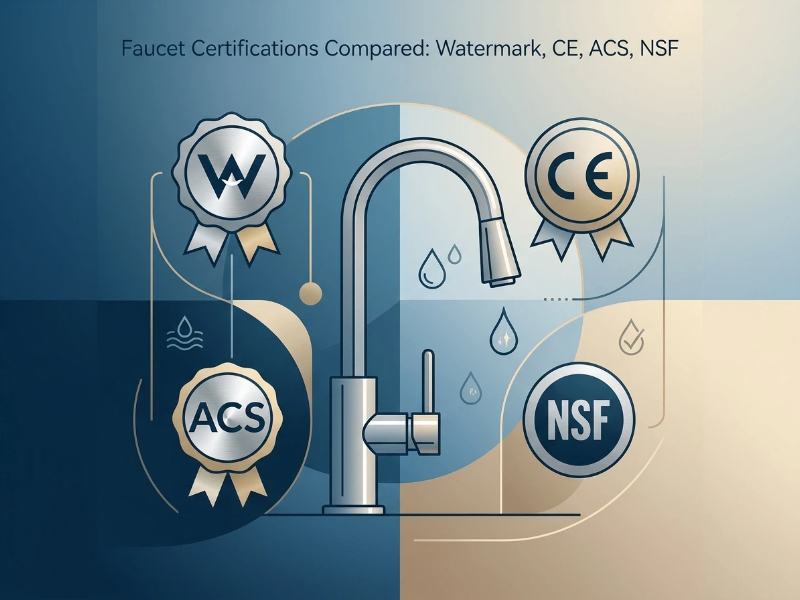
Navigating faucet certifications is one of the biggest challenges for B2B importers, distributors, and project procurement managers. Every market enforces its own regulatory framework — a faucet legal in Europe may be rejected at Australian customs, and vice versa. WaterMark, CE, ACS, and NSF are the four certifications that dictate market access across Australia, Europe, France, and North America. This guide breaks down what each certification covers, which markets require it, how much it costs, and how to verify authenticity — so you can source with confidence and avoid costly compliance mistakes.
For B2B buyers — whether you’re a hotel procurement manager, an import distributor, or a plumbing wholesaler — faucet certifications are not optional paperwork. They are legal requirements. Without the correct certification, your shipment can be seized at customs, your projects can fail inspection, and your reputation can take a permanent hit.
In Australia, non-compliant plumbing products can incur fines up to AUD 500,000 for companies. In the U.S., 48 states mandate NSF/ANSI 61 compliance for any faucet contacting drinking water. France’s ACS certification is non-negotiable for public health compliance. These are not recommendations — they are regulatory gates that determine whether your product reaches the shelf at all.
More importantly, certified products command 20–40% higher prices than uncertified alternatives, according to Alibaba.com B2B platform data. Certifications unlock premium distribution channels: government contracts, hotel chains, and large-scale commercial bathroom projects all demand verified compliance before they even open a quote. For importers sourcing from China, working with a manufacturer that already holds multiple certifications — like FAAO’s certified basin faucets — eliminates months of testing delays and thousands in upfront certification costs.
WaterMark is Australia’s mandatory plumbing product certification scheme, administered by the Australian Building Codes Board (ABCB). It applies to any plumbing product — including faucets — that connects to the drinking water supply. If you want to sell faucets in Australia or New Zealand, WaterMark Level 1 certification is non-negotiable.
WaterMark is not self-declarable — you must work with an accredited certification body such as IAPMO, NSF, or SAI Global. Each certified product receives a unique license number that buyers can verify in the public WaterMark Product Database.
Alongside WaterMark, all faucets sold in Australia must display a Water Efficiency Labelling and Standards (WELS) star rating (1–6 stars). Minimum flow rates range from 9 L/min (3 stars) to 4.5 L/min (6 stars). A faucet can pass WaterMark and still be rejected at retail if it lacks a compliant WELS label.
Need WaterMark-Certified Faucets for the Australian Market?
FAAO offers a full range of WaterMark-certified basin, kitchen, and shower faucets with compliant WELS ratings. Ready to ship or customize under OEM/ODM arrangements.
CE marking is mandatory for faucets placed on the EU market under the Construction Products Regulation (EU) No 305/2011. It signals that the product meets EU health, safety, and environmental protection standards across all 27 member states plus EEA countries (Norway, Iceland, Liechtenstein).
CE marking is the entry ticket to Europe, but it is not a blanket solution. France requires the additional ACS certification (covered in the next section), and the United Kingdom now mandates WRAS approval post-Brexit. Importers targeting multiple European markets should budget for layered certifications rather than assuming CE alone suffices.
Critical for importers: Always request the Declaration of Performance (DoP) alongside the CE certificate. A CE mark without a valid, traceable DoP is non-compliant and will not pass customs scrutiny. When evaluating Chinese faucet manufacturers, ask to see both documents for the specific model you intend to import.
ACS (Attestation de Conformité Sanitaire) is France’s mandatory sanitary conformity certification for any material or product that contacts drinking water. Unlike CE marking, which covers mechanical and general safety aspects, ACS focuses exclusively on public health — specifically, whether materials leach harmful substances into water over extended contact periods.
The critical distinction that catches many importers off guard: a CE-marked faucet can legally enter the EU, but it cannot be sold in France without ACS. CE and ACS address different regulatory domains — CE is about product safety and performance, ACS is about drinking water health. If France is anywhere in your distribution plan, ACS is a separate must-have, not an optional add-on.
Sourcing for the French or European Market?
FAAO faucets are CE and ACS certified, covering both EU-wide and France-specific compliance requirements. Explore our full certified product line.
In the United States and Canada, NSF certification is the dominant compliance framework for faucets and plumbing products. Two standards work together to cover both water safety and material composition:
Critical insight for B2B buyers targeting North America: Many commercial specifications — particularly for hospitality, multi-family residential, and government projects — also require cUPC certification from IAPMO. This certification verifies that the faucet meets the Uniform Plumbing Code for mechanical compatibility and flow performance. If you’re supplying commercial kitchen faucets or specifying for hotel projects, budget for NSF + cUPC as a combined requirement.
Targeting North America? Source NSF-Certified Faucets
FAAO’s NSF/ANSI 61 & 372 compliant faucets meet U.S. and Canadian standards. Full certification documentation and test reports provided with every order.
| Fonctionnalité | Filigrane | CE Marking | ACS | NSF 61/372 |
|---|---|---|---|---|
| Target Market | Australia, New Zealand | EU (27 countries) + EEA | France | USA, Canada |
| Legal Status | Mandatory (Level 1) | Mandatory | Mandatory (in France) | Mandatory in 48 states |
| Primary Focus | Plumbing safety & performance | Safety, health, environment | Drinking water health | Water safety & lead content |
| Key Standards | WaterMark Scheme, WELS | EN 817, EN 200 | French MoH regulations | NSF/ANSI 61, NSF/ANSI 372 |
| Cost (Approx.) | AUD 4,000–10,000 | EUR 2,000–6,000 | EUR 3,000–7,000 | USD 5,000–15,000 |
| Timeline | 10–14 weeks | 4–8 weeks | 8–12 weeks | 8–12 weeks |
| Validity | 5 years | Indefinite* | 5 years | Annual renewal |
| Self-Declaration | Not permitted | Limited (not recommended) | Not permitted | Not permitted |
| Annual Surveillance | Oui | No* | Oui | Yes (unannounced) |
* CE marking validity is indefinite but requires updates if harmonized standards change. Annual surveillance is not mandatory under CE but is part of NSF and WaterMark schemes.
Selecting the correct certification comes down to three straightforward questions:
Pro tip for importers: If you partner with a manufacturer that already holds multiple certifications — like FAAO, which carries CE, ACS, and WaterMark — you can leverage their existing certifications through OEM/ODM arrangements. This eliminates months of testing delays and thousands in upfront costs, getting your products to market significantly faster.
Not Sure Which Certification Your Market Requires?
Our team helps B2B buyers identify exact certification requirements for their target markets. Get a free compliance consultation and accelerate your time to market.
Counterfeit or expired certifications are a real and costly risk in the faucet import industry. Industry surveys indicate that up to 15% of certification documents presented by unvetted suppliers contain discrepancies — expired dates, mismatched model numbers, or entirely fabricated certificates. Here is a five-step verification process every B2B buyer should follow:
For importers and distributors, the most efficient path to multi-market compliance is partnering with a manufacturer that has already invested in certifications across regions. FAAO — a sanitary ware manufacturer founded in 2001 with a fully integrated production process covering foundry, machining, polishing, and assembly — holds CE, ACS, and WaterMark certifications alongside ISO9001 quality management and SGS product testing credentials.
What this means for B2B buyers is straightforward: instead of commissioning separate certification cycles for each market, you leverage FAAO’s existing certifications through OEM and ODM partnerships. Your branded products ship with valid, verified compliance documentation from day one — no 14-week certification delays, no lab rejections, no customs surprises.
FAAO’s faucet portfolio spans robinets de lavabo, kitchen faucets, shower faucets, robinets de baignoire, et concealed shower sets — all designed to meet the technical specifications and material requirements of each certification standard. With global distribution partners including Bunnings and Amazon, FAAO’s compliance framework is already proven at scale.
Ready to Source Certified Faucets for Global Markets?
FAAO holds CE, ACS, and WaterMark certifications with full compliance documentation. OEM/ODM available — your brand, our certifications, zero delays.
Faucet certifications are not bureaucratic overhead — they are your license to operate in the world’s most profitable plumbing markets. Whether you’re importing into Australia (WaterMark), distributing across Europe (CE + ACS), or supplying North American commercial projects (NSF + cUPC), getting the right certification upfront prevents shipment rejections, project delays, and legal liabilities that can cost far more than the certification itself. Partner with a manufacturer that already holds these certifications, verify every document through official databases, and you will be positioned to compete — and win — in any market you target.
Yes. CE marking permits entry into the EU market, but France additionally requires ACS (Attestation de Conformité Sanitaire) for any faucet that contacts drinking water. CE addresses product safety and performance under EN 817 and EN 200, while ACS addresses drinking water health through migration testing. Both certifications are mandatory for the French market — possessing only one is insufficient.
Absolutely. Many manufacturers design faucets to meet multiple certification standards from the start. A single faucet model can carry WaterMark, CE, ACS, and NSF certifications simultaneously, enabling it to be sold across Australia, Europe, and North America without any design modifications. This is the most cost-efficient approach for global B2B distributors.
Certification timelines range from 4 weeks (CE with self-declaration) to 14 weeks (WaterMark Level 1). The main variables are the testing laboratory’s current queue, whether the product passes on the first submission attempt, and how quickly all required documentation and samples are provided. A realistic budget is 8–12 weeks for most certifications. Rush services are sometimes available at premium rates.
Consequences vary by jurisdiction but typically include: customs seizure and shipment rejection at the port of entry, regulatory fines (up to AUD 500,000 per violation in Australia), mandatory product recalls, failed building inspections that delay project handover, voided insurance coverage for non-compliant installations, and permanent damage to the importer’s compliance record — making future shipments subject to heightened scrutiny.
Always verify through the official certification body’s online database — never through the manufacturer’s website or a standalone PDF. For NSF, search the NSF product listings database. For WaterMark, use the ABCB WaterMark Product Database. For ACS, verify with the issuing laboratory (CSTB or CARSO). Also request the full test report with raw data — quantitative test results are significantly harder to forge than certificate documents. Reputable manufacturers will provide these without hesitation.
 Optimized by Seraphinite Accelerator
 Tél :
Tél :  E-mail:
  French
  English
  Spanish
  Russian
  Portuguese