

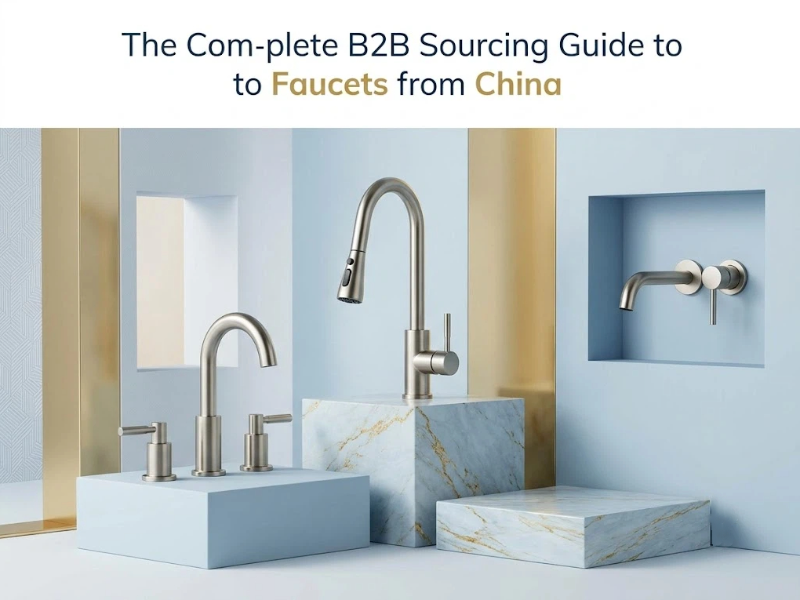
Sourcing faucets from China can cut your procurement costs by 30 to 50 percent — but only if you know how to navigate the process. With over 2,000 faucet manufacturers concentrated in regions like Zhejiang and Guangdong, finding the right supplier feels overwhelming. This guide breaks down everything B2B buyers need: from vetting manufacturers and verifying certifications to negotiating MOQs and running quality inspections. Whether you are a distributor, contractor, or procurement manager, you will walk away with a practical framework for sourcing faucets that meet your specs, budget, and timeline.
China produces more than 60% of the world’s faucets, and the supply chain has matured dramatically over the past decade. Today’s leading manufacturers operate 20,000-square-meter facilities with in-house foundries, CNC machining centers, and automated polishing lines. The cost advantage is real — labor, brass, zinc alloy, and electroplating all come cheaper when sourced domestically — but the bigger win is flexibility. Need a custom finish? A modified spout angle? A private-label box design? Chinese factories can accommodate these changes faster and at lower tooling costs than manufacturers in Europe or North America.
That said, the market is fragmented. Some factories produce 500,000 faucets a year for global brands; others are trading companies that outsource everything. Knowing the difference — and knowing how to verify what a supplier tells you — is what separates a smooth sourcing experience from a costly mistake.
Explore FAAO’s Complete Faucet Catalog
Browse basin, kitchen, shower, and bathtub faucets from a manufacturer with 20+ years of export experience.
Most faucet production in China clusters around two regions. Yuhuan, Zhejiang accounts for roughly one-third of national output and specializes in brass-bodied faucets — basin mixers, kitchen taps, and shower valves. Kaiping, Guangdong focuses on mid-range and premium segments, with stronger design capabilities and a higher concentration of export-oriented factories. Knowing where your supplier sits geographically helps you anticipate lead times, shipping costs, and specialization.
Within these clusters, you will encounter three types of suppliers:
A quick way to separate factories from trading companies: ask for a production floor video, check their business license for “manufacturer” vs. “trading” classification, and look for ISO 9001 certification with the actual factory address listed.
Before contacting a single supplier, get specific. Vague inquiries get vague quotes. Prepare a one-page spec sheet that includes:
The more detail you provide, the faster a serious manufacturer can quote accurately — and the faster you can weed out suppliers who cannot meet your requirements.
Start with multiple channels. Alibaba and Made-in-China are the obvious starting points, but do not stop there. Industry trade shows like Canton Fair and ISH Shanghai put you face-to-face with factory reps. Referrals from other buyers in your network often surface suppliers who do not advertise aggressively but deliver consistently.
Shortlist 5 to 8 candidates. For each, check:
Narrow to 3 finalists before moving to the audit stage.
This is where most sourcing projects go wrong — buyers skip verification and pay for it later. A proper supplier audit covers four areas: legal status, production capability, quality management, and social compliance.
Request the supplier’s business license, ISO 9001 certificate, and any product certifications. Cross-check that the factory address on the certificate matches the address they gave you. If possible, hire a third-party inspection agency (SGS, TÜV, Intertek) to conduct an on-site factory audit. The cost — typically $300 to $800 — is trivial compared to a bad order.
Use the checklist below during your audit. It works whether you visit in person or send a third-party inspector:
| Audit Category | What to Check | Pass / Fail |
|---|---|---|
| Legal & Ownership | Business license valid; registered capital matches claims; factory address confirmed | ☐ |
| Production Capacity | CNC machines, polishing lines, assembly stations match stated output; capacity headroom for your volume | ☐ |
| Quality Control | In-house water pressure testing, salt spray testing, surface inspection records on file | ☐ |
| Material Traceability | Brass bar stock sourced from named suppliers; material test reports available | ☐ |
| Workforce & Management | Experienced technical staff; dedicated QC team separate from production; English-speaking sales contact | ☐ |
| Compliance | No child labor; safe working conditions; environmental waste handling for plating line | ☐ |
Suppliers who pass this audit are worth the sample stage. Those who resist or deflect — walk away.
Order samples from your 2 to 3 shortlisted factories. Expect to pay $50 to $200 per sample including shipping — this is an investment, not an expense. When samples arrive, evaluate them against these criteria:
Document everything. Photos, test results, and side-by-side comparisons give you leverage when negotiating and when setting the quality benchmark for production.
Faucet pricing from Chinese manufacturers is quoted FOB (Free on Board) or EXW (Ex Works) in USD. A typical brass basin faucet ranges from $4 to $18 FOB depending on weight, finish, and cartridge brand. Kitchen pull-down faucets run $8 to $25. Shower mixers sit between $6 and $20.
MOQ for faucet manufacturing in China usually starts at 500 to 1,000 pieces per model. Established factories with large catalogs may accept 300-piece MOQ for standard items. If you need lower MOQ, expect a 10 to 20% unit price premium.
Negotiate these terms explicitly:
Need OEM or ODM Faucet Manufacturing?
FAAO offers both OEM and ODM services with 200+ patents and full in-house production. Tell us your specs.
Never ship blind. A pre-shipment inspection (PSI) catches defects before they become your problem. The industry standard follows AQL 2.5 (Acceptance Quality Limit) under ISO 2859-1. Your inspector should check:
A typical PSI costs $250 to $350 per day and covers one factory. If the inspection fails, you have contractual grounds to demand rework before releasing the balance payment. For more on how cartridge quality affects water flow, read how a basin faucet cartridge controls water flow.
For orders under 5 cartons, air freight or express (DHL, FedEx) makes sense. For anything larger, sea freight is the only economical option. A 20-foot container holds roughly 3,000 to 5,000 faucets depending on packaging. Typical sea freight from Ningbo or Shenzhen to Los Angeles runs $1,500 to $3,500; to Rotterdam, $2,000 to $4,000.
Work with a licensed customs broker in your destination country. They will handle duty classification (faucets typically fall under HS code 8481), import documentation, and compliance checks. Make sure your supplier provides:
Import duties on faucets range from 0% to 8% depending on your country’s trade agreements with China. Factor this into your landed cost calculation.
Certifications are not optional — they are your legal ticket to sell in a market. Here is what matters:
Ask for certification documents upfront and verify them on the issuing body’s website. Counterfeit certificates exist. For buyers targeting commercial projects, understanding single handle vs double handle basin faucets for commercial use also helps ensure your product spec meets project requirements.
Two production models dominate Chinese faucet manufacturing:
OEM (Original Equipment Manufacturer): You provide the design, drawings, or sample. The factory produces exactly to your spec. Best when you have an established product line, proprietary designs, or specific brand requirements. Tooling costs apply, but you own the mold.
ODM (Original Design Manufacturer): The factory designs the product. You pick from their existing catalog and apply your brand. Faster to market, lower upfront cost, but you share the design with other buyers. Ideal for new distributors building an initial catalog.
Choosing between them depends on your business model. Distributors entering the market often start ODM, then transition to OEM once volume justifies custom tooling. For a deeper comparison, read our guide on OEM vs ODM faucet manufacturing partnership models. If you are sourcing for hospitality clients, our article on choosing basin faucets for hotel bathroom projects covers specification priorities.
Even experienced buyers make mistakes. Here are the ones we see most:
Source from a Certified Manufacturer You Can Trust
FAAO holds ISO 9001, SGS, CE, ACS, and Watermark certifications — with 200+ patents and 80+ export markets.
MOQ for faucet manufacturing in China generally starts at 500 to 1,000 pieces per model. Standard catalog items from larger factories may accept 300 pieces. Custom OEM designs with new tooling typically require 1,000+ pieces to amortize mold costs. If you need smaller quantities, expect a unit price premium of 10 to 20%, or consider working with a trading company that consolidates orders.
Production lead time runs 30 to 45 days for standard models and 45 to 60 days for custom OEM projects. Sea freight adds 15 to 35 days depending on destination (US West Coast: ~15 days; Europe: ~30 days). Add 7 to 10 days for customs clearance. Plan for 60 to 90 days total from order confirmation to warehouse arrival. Always build a 15 to 20% buffer for delays.
It depends on your destination market. EU requires CE. Australia and New Zealand require Watermark. France requires ACS. The US expects WaterSense compliance for commercial projects. At the factory level, ISO 9001 indicates a systematic quality management process. Always verify certifications on the issuing body’s official website — counterfeit documents are not uncommon.
Yes. Most established manufacturers offer both OEM (your design, their production) and ODM (their design, your brand). Customization options include body shape, spout length, handle style, finish (chrome, matte black, brushed gold, PVD), cartridge brand, and packaging. Tooling fees for custom molds run $2,000 to $8,000. For existing ODM products, customization is limited to finish, logo, and packaging.
Three layers of QC are essential. First, approve a golden sample before production starts — this becomes the reference standard. Second, schedule a mid-production inspection to catch issues early. Third, run a pre-shipment inspection under AQL 2.5 standards before releasing the balance payment. Hire a third-party inspection agency (SGS, TÜV, Intertek) if you cannot visit the factory yourself. Never pay the full balance without a passed PSI report.
Sourcing faucets from China is a high-reward strategy — but success comes down to due diligence, not luck. Vet your suppliers thoroughly, insist on the right certifications, and never skip pre-shipment inspections. Build relationships with manufacturers who invest in their quality systems, and you will turn sourcing into a competitive advantage. FAAO has spent over 20 years refining that process, supplying faucets to buyers in 80+ countries with ISO 9001, CE, Watermark, and ACS certifications. Ready to put this framework into action? Start by shortlisting certified manufacturers, requesting samples, and comparing terms. The right partner is out there — now you know how to find them.
 Optimized by Seraphinite Accelerator
 Tél :
Tél :  E-mail:
  French
  English
  Spanish
  Russian
  Portuguese