

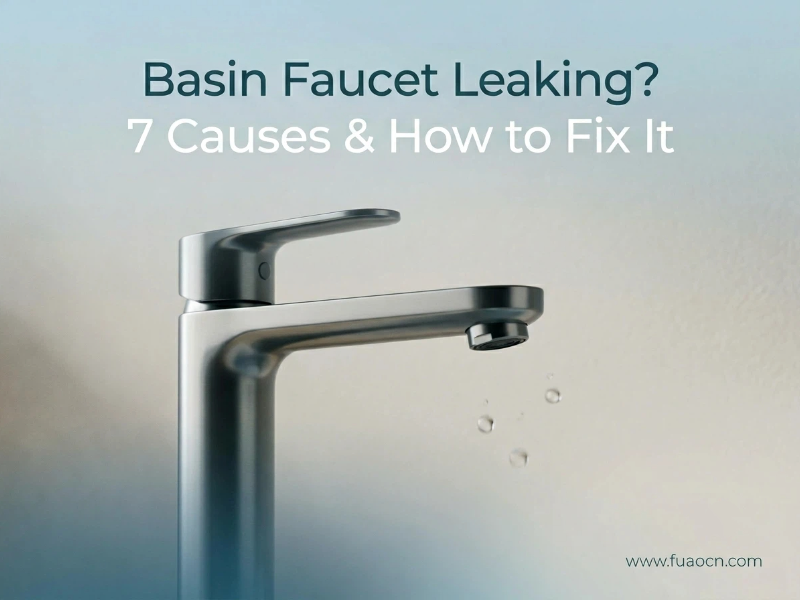
A dripping basin faucet isn’t just an annoyance—it wastes up to 3,000 gallons of water per year, stains sink surfaces, and in commercial settings like hotels and office buildings, can trigger costly water damage claims. Understanding why a basin faucet leaks and knowing how to fix it is essential for procurement professionals, contractors, and property managers who need reliable, long-lasting plumbing solutions.
In this guide, we break down the 7 most common causes of basin faucet leaks and provide step-by-step fix instructions for each one. Whether you’re troubleshooting an existing installation or evaluating faucet quality for a bulk purchase, this resource from FAAO—a sanitary ware manufacturer with 30 years of global experience—gives you the expertise to act decisively.
What happens: Inside every basin faucet, rubber O-rings and washers create the watertight seal that prevents water from escaping around the spout base or handle joints. Over time, these rubber components harden, crack, or flatten under repeated compression and thermal cycling. When the seal degrades, water seeps through the gap—often appearing as a slow drip from the robinet de lavabo spout or a trickle around the handle.
Why it matters for B2B buyers: In hospitality and commercial projects with dozens or hundreds of faucet units, O-ring wear is the single most frequent maintenance call. Selecting faucets with high-quality, durable seals (like FAAO’s brass cartridges with precision-engineered O-rings) dramatically reduces after-installation service costs.
What happens: The valve seat is the brass or stainless surface inside the faucet body that the washer presses against to stop water flow. If the valve seat becomes pitted, corroded, or uneven—common in faucets made from low-grade metals—water bypasses the seal even when the washer is in good condition. This produces a persistent drip from the basin faucet spout, often noticeable when the faucet is fully closed.
Why it matters for B2B buyers: Valve seat corrosion is directly tied to material quality. Faucets manufactured with high-purity brass (like FAAO’s CZ122 brass bodies) resist corrosion far better than those made with recycled or zinc-rich alloys. For procurement teams sourcing robinets de lavabo for humid or high-use environments, material grade is a critical differentiator.
What happens: Basin faucets connect to the water supply through flexible hoses or rigid pipes, typically fastened with nuts at the faucet base and the angle valve. If these connections loosen over time—due to vibration, thermal expansion, or initial under-tightening—water leaks at the joint. You’ll typically see water pooling under the basin or dripping from the supply line connection.
Why it matters for B2B buyers: In multi-unit installations (hotels, apartment complexes), loose connections are a top source of emergency maintenance calls. Using faucets with precision-machined threads et factory-tested connection seals (standard in FAAO’s manufacturing process) reduces this risk significantly.
What happens: Modern single-handle robinets de lavabo use a ceramic cartridge to control water flow and temperature. While ceramic discs are highly durable, the cartridge housing (typically plastic or brass) can crack under impact, freeze damage, or manufacturing defects. A cracked cartridge leaks water continuously—often from both the spout and around the handle—regardless of whether the faucet is open or closed.
Why it matters for B2B buyers: Cartridge quality is the heart of faucet reliability. FAAO uses 35mm ceramic cartridges from certified suppliers, tested to 500,000+ cycle lifespans. For projects requiring long-term reliability—commercial buildings, rental properties, hospitality—cartridge grade is a decisive purchasing factor.
What happens: Standard basin faucets are designed for water pressure between 0.5–1.0 MPa (50–100 PSI). When supply pressure exceeds this range—common in high-rise buildings, municipal systems with pressure boosting, or poorly regulated commercial plumbing—the faucet’s internal seals and components are stressed beyond their design limits. This accelerates O-ring wear, strains cartridge discs, and forces water through micro-gaps that would otherwise remain sealed.
Why it matters for B2B buyers: High water pressure is an invisible cause that turns a quality faucet into a frequent service item. For procurement teams, the solution isn’t just buying better faucets—it’s ensuring the entire plumbing system includes proper pressure regulation. FAAO’s robinets de lavabo are pressure-tested at 1.6 MPa to exceed common operating ranges, but system-level pressure management remains essential.
What happens: In regions with hard water (high calcium and magnesium content), minerals precipitate inside the faucet body, around the spout aerator, and on internal sealing surfaces. Over time, this buildup creates a rough, crystalline layer that prevents O-rings and washers from forming a complete seal. The result: slow, persistent leaks from the robinet de lavabo spout or handle area, often accompanied by visible white or green scale deposits.
Why it matters for B2B buyers: Hard water is a regional variable that procurement teams must account for when specifying robinets de lavabo for projects in affected areas (common in Middle East, South Asia, and parts of South America). FAAO faucets feature anti-scale aerators et chrome-plated interiors that resist mineral adhesion, reducing maintenance frequency in hard-water environments.
What happens: A basin faucet designed for a single-hole installation won’t seal correctly on a three-hole basin—and vice versa. Incorrect mounting hole alignment, missing gaskets, overtightened mounting nuts (which warp the base gasket), or using a deck-mount faucet on a wall-mount basin all create leak pathways at the faucet base. This type of leak appears immediately after installation, making it easy to identify but costly to fix if the wrong faucet was purchased in bulk.
Why it matters for B2B buyers: This is a specification error, not a product defect—yet it’s one of the most expensive mistakes in commercial procurement. Ordering the wrong faucet type for a project means either field modifications (which compromise quality) or full replacement. FAAO’s technical support team assists buyers with specification verification before order placement, ensuring the selected basin faucet matches the installation requirements.
Use this table to match your leak symptom to the most likely cause and recommended action:
| Leak Symptom | Most Likely Cause | Quick Action |
|---|---|---|
| Drip from spout when faucet is closed | Worn O-ring / Corroded valve seat (Causes 1 & 2) | Replace O-ring first; resurface valve seat if needed |
| Water around handle base | Cracked cartridge / Degraded O-ring (Causes 1 & 4) | Replace cartridge and handle O-ring |
| Water under the basin at supply lines | Loose connection / Damaged washer (Cause 3) | Tighten connection; replace washer if tightening fails |
| Leak at faucet base on basin deck | Wrong faucet type / Missing gasket (Cause 7) | Verify faucet-to-basin compatibility; reinstall with correct gasket |
| Intermittent drip, worse at certain times | High water pressure (Cause 5) | Measure pressure; install PRV if above 1.0 MPa |
| Slow drip + visible white/green scale | Mineral buildup (Cause 6) | Descale aerator and internals; consider water softener |
Not every leaking faucet deserves a repair. In commercial and hospitality procurement, the total cost of repeated maintenance often exceeds the cost of a quality replacement. Consider replacing the faucet when:
Preventing leaks starts with choosing the right faucet. FAAO’s robinets de lavabo are engineered with the quality features that eliminate the most common leak causes:
A persistent drip from a closed faucet most commonly indicates a worn O-ring or washer inside the cartridge (Cause 1) or a corroded valve seat (Cause 2). The seal surface is no longer smooth enough to stop water flow completely. Replace the O-ring first—it’s the cheapest fix. If the drip continues, resurface or replace the valve seat. In commercial settings where downtime is costly, consider upgrading to a FAAO basin faucet with a ceramic cartridge, which eliminates washer-based seal failure entirely.
Yes, for most common causes (O-ring replacement, connection tightening, aerator descaling). These repairs require basic tools: a wrench, screwdriver, and replacement parts. However, if the leak involves valve seat resurfacing ou cartridge replacement in a concealed or wall-mounted faucet, professional installation is recommended to avoid damaging surrounding tile or plumbing. FAAO’s technical team can provide model-specific repair guidance—contact us at FAAO Support.
In residential settings, quality O-rings typically last 5–8 years. In commercial/high-use environments (hotels, hospitals, office buildings), lifespan drops to 3–5 years due to higher cycle frequency and water pressure. FAAO’s precision-engineered O-rings, paired with brass cartridges, extend this interval by approximately 30% compared to standard components. Proactive replacement during scheduled maintenance prevents emergency leak calls.
Not necessarily. If only the O-ring or washer is worn, a simple replacement restores full function. However, if you observe multiple failing components (O-ring + valve seat + cartridge), visible body corrosion, or the faucet is incompatible with the basin, replacement is more cost-effective than cumulative repairs—especially for B2B procurement where total cost of ownership matters. FAAO offers leak-resistant basin faucets designed to minimize the most common failure points.
Standard operating range: 0.5–1.0 MPa (50–100 PSI). Pressure above 1.0 MPa stresses internal seals and accelerates wear on all components. FAAO basin faucets are factory-tested at 1.6 MPa for a safety margin, but sustained operation above 1.0 MPa still shortens component life. Install a pressure-reducing valve (PRV) at the building supply line if pressure exceeds safe range, and verify with a gauge reading.
Yes. Hard water (high calcium/magnesium content) deposits minerals on internal sealing surfaces, creating a rough layer that prevents O-rings and washers from forming a complete seal. This is a significant factor in regions like the Middle East, South Asia, and parts of South America. FAAO basin faucets feature chrome-plated interiors and anti-scale aerators that resist mineral adhesion. For buildings in hard-water zones, a water softener at the supply level provides the best long-term protection.
A cracked cartridge typically produces a continuous leak from both the spout and around the handle, regardless of whether the faucet is open or closed. You may also notice the handle feels loose or doesn’t turn smoothly. To confirm, shut off water, remove the handle and cartridge, and inspect for visible cracks or chips in the ceramic discs. If found, replace with the manufacturer’s exact cartridge model. FAAO provides model-specific cartridges for every faucet series.
A spout leak (drip when faucet is closed) points to internal seal failure—O-rings, valve seat, or cartridge. A base leak (water around the faucet mount on the basin deck) points to installation issues—missing gasket, wrong faucet type, or overtightened/under-tightened mounting nuts. Different leak locations require different fixes. Use the Quick Diagnosis Checklist above to match your symptom to the correct cause.
Significantly yes. High-purity brass (like FAAO’s CZ122) resists corrosion, maintains dimensional stability under thermal cycling, and provides a durable valve seat surface. Zinc alloy faucets corrode faster, warp under heat, and develop internal pitting that destroys sealing surfaces. For commercial and hospitality projects where longevity matters, brass basin faucets deliver 2–3x the leak-free lifespan of zinc alloy alternatives. Explore FAAO’s brass basin faucet collection for project-grade durability.
Focus on these 5 quality markers: (1) Brass body (CZ122 grade or equivalent)—resists corrosion; (2) Ceramic cartridge with documented cycle testing (500K+ cycles)—eliminates washer failure; (3) Precision O-rings from certified suppliers—maintain seal integrity; (4) Chrome interior plating—resists hard water scale; (5) Pressure testing at 1.6+ MPa—safety margin for variable supply conditions. FAAO basin faucets meet all five criteria. Browse the full range here.
| Stop Leaks Before They Start FAAO basin faucets are engineered with 30 years of manufacturing expertise to eliminate the most common leak causes at the source.
|
5 erreurs courantes à éviter lors de l’installation d’un robinet de lavabo à double poignée — Installation errors that can cause leaks and performance issues
Robinets de lavabo VS. Robinets de lavabo à double poignée — Which faucet type is right for your project
Quelle doit être la hauteur d’un robinet de lavabo mural ? — Correct installation height for wall-mounted basin faucets
What Is the Difference Between Wall Mounted and Sink Mounted Taps? — Understanding faucet mounting types (relevant to Cause 7)
Le guide ultime des robinets de baignoire : comment choisir celui qui convient à votre baignoire — Faucet selection principles applicable to all faucet types
 Optimized by Seraphinite Accelerator
 Tél :
Tél :  E-mail:
  French
  English
  Spanish
  Russian
  Portuguese