

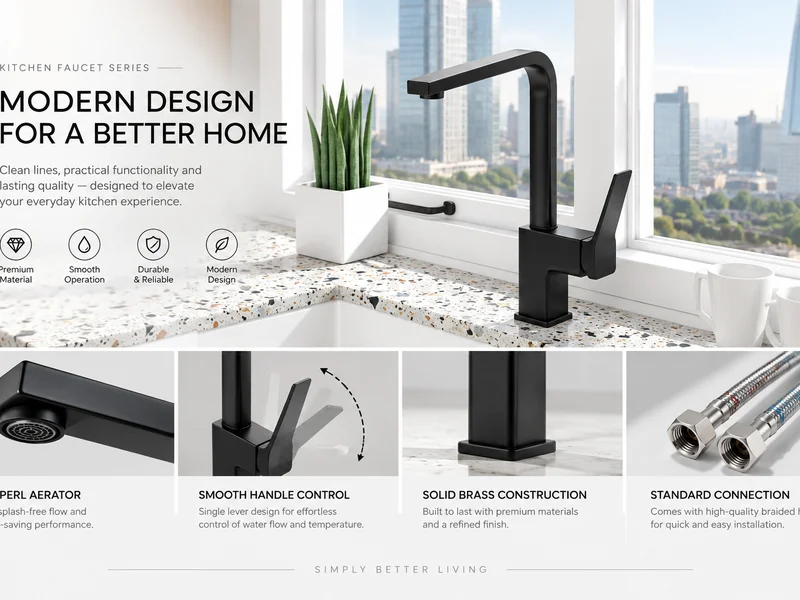
Specifying a kitchen faucet for multi-unit residential, hotel or commercial-kitchen projects is not the same as picking one for a single home. Buyers have to weigh body material, cartridge life, spout clearance, flow rate, certification and finish durability in one decision — usually across hundreds or thousands of units. This FAAO guide walks B2B procurement, project and sourcing teams through an 8-step framework for choosing the right kitchen faucet, with the technical thresholds, market-specific certifications and OEM considerations that matter when you order in volume.
Get a tailored kitchen faucet specification for your project
FAAO is a Wenzhou-based manufacturer of brass and stainless-steel kitchen faucets serving distributors, importers and project buyers in 50+ markets. Send us your quantities, finish, certification target and rough-in requirements.

Before you compare finishes or cartridge brands, lock down where the faucet will actually live. A pull-out sprayer that is perfect for a serviced apartment will be out of spec for a hotel back-of-house, and a pre-rinse unit that works in a restaurant kitchen is overkill for residential multi-unit. The table below maps common B2B project types to the configuration we recommend, based on FAAO factory data and feedback from 500+ bulk orders.
| Project type | Recommended mount | Body material | Spout type | Cartridge / valve | Indicative flow rate |
|---|---|---|---|---|---|
| Multi-unit residential / apartment | Deck-mounted, single hole | Brass (Cu≥59%) | Mid-arc, pull-out dual spray | 35 mm ceramic disc, 500,000 cycles | 6–8 L/min (1.6–2.1 gpm) |
| Hotel guestroom & serviced apartment | Deck-mounted, single hole | Brass (Cu≥59%) | Mid-arc, pull-down or pull-out | 35 mm ceramic disc, EN 817 / ASME A112.18.1 | 6–8 L/min |
| Hotel display kitchen / front-of-house | Wall-mounted, concealed valve | Brass body, stainless spout | Gooseneck, fixed | 1/2″ ceramic disc concealed body | 6–8 L/min |
| Restaurant & commercial kitchen | Deck-mounted, single hole, heavy-duty base | Brass with reinforced locknut | Pre-rinse spring or pull-down | 35–40 mm ceramic disc, 500,000+ cycles | 9–15 L/min (2.4–4.0 gpm) |
| Public housing / institutional | Deck-mounted, 3-hole with deck plate | Latão ou aço inoxidável | Mid-arc, fixed | 35 mm ceramic disc, ADA-compliant lever | 6–8 L/min |
You can browse the full range inside our commercial-grade kitchen faucet collection, or jump straight to the pre-rinse and pull-down commercial kitchen faucet line for restaurant and back-of-house projects.

The body is the single biggest driver of kitchen faucet price, weight and corrosion resistance. For B2B projects you will see three options again and again: brass (the default for premium and commercial work), stainless steel (for hygiene-sensitive or coastal markets) and zinc alloy (for entry-level residential). Do not spec zinc on a multi-unit or commercial project — the long-term failure rate is too high to absorb into a maintenance budget.
| Material | Cu / Cr / Ni content | Salt-spray test (ASTM B117) | Best-fit project | Relative cost index (brass=100) |
|---|---|---|---|---|
| Solid brass (Hpb59-1 / CW617N) | Cu ≥ 59%, Pb ≤ 1.8% | 48–96 h (chrome plated) / 24 h (raw) | Residential, hotel, commercial, multi-unit | 100 |
| Stainless steel 304 / 316 | Cr ≥ 18%, Ni ≥ 8% (304); 316 adds Mo 2–3% | 96–200 h (316 marine grade) | Hospitals, coastal, drinking water lines | 130–160 |
| Zinc alloy (Zamak) | Zn > 90% | 24 h (typical) | Entry-level residential, single-home replacement | 55–70 |
For most B2B buyers, a Cu≥59% brass body with a multi-layer chrome plate is the safest spec. If you are supplying North American hospitality, drinking water or healthcare projects, move to 304/316 stainless. Our solid brass kitchen faucet line uses Hpb59-1 ingot cast in-house, with optional 316 stainless spout on request.
The cartridge is the part that fails first. Two factors matter: the disc material (ceramic, not plastic) and the cycle rating. A ceramic disc cartridge rated to 500,000 open/close cycles (EN 817 or ASME A112.18.1) will outlast a 200,000-cycle cartridge by a factor of two — and the price difference is usually under $0.50 per unit at OEM volume.
Specify the cartridge by standard, not by brand name. EN 817 (Europe), ASME A112.18.1 / CSA B125.1 (North America), AS/NZS 3718 (Australia / New Zealand) and GB 18145 (China) all run comparable cycle tests, but the flow rate, leak rate and salt-spray thresholds differ. If your faucet is going to multiple markets, ask the factory to map one cartridge to all relevant standards in the same test report — this is something FAAO does as a standard service for project orders above 1,000 units.
For pre-rinse commercial faucets, the cartridge is paired with a heavy-duty spring and a reinforced lever. Do not reuse a residential pull-down cartridge in a restaurant kitchen — the duty cycle is different and the lever geometry is not built for gauntlet hands.
Spout height and reach are the two dimensions procurement teams most often get wrong, because they are rarely listed on the box. They should always be checked against the sink depth and the user profile. A pot-filler height of 220 mm is fine over a 150 mm-deep bowl, but useless over a 200 mm farmhouse sink.
| Spout height (H) | Spout reach (L) | Recommended sink depth | Best use case | User profile |
|---|---|---|---|---|
| 140–180 mm | 110–140 mm | 150–170 mm | Compact kitchenette, hotel guestroom | Single user, hand-washing only |
| 200–260 mm | 160–200 mm | 170–190 mm | Standard apartment, multi-unit | Family of 2–4 |
| 280–360 mm | 200–240 mm | 190–220 mm | Family home, show kitchen, light commercial | Family of 4–6, large pots |
| 400–600 mm (pre-rinse spring) | 250–320 mm | 220–280 mm (commercial sink) | Restaurant, commercial kitchen, hotel BOH | Operator with tray, pot or sheet pan |
Leave at least 100 mm between the lowest point of the spout and the bottom of the sink bowl for hand washing. For a wall-mounted faucet in a hotel display kitchen, the rough-in height should be set 200–250 mm above the rim — get this wrong and you will be cutting tiles after the fact.
Send us your sink drawing, we will match the spout
Share a sketch of sink depth, deck thickness and handle clearance. FAAO engineers will return a spout-height and reach recommendation plus a marked-up spec sheet within 48 hours.
Spray function is the area where marketing copy and engineering reality diverge the most. The three configurations below cover roughly 95% of B2B kitchen faucet orders.
| Spray function | Hose length | Cycle life of hose / docking | Best-fit project | Things to watch |
|---|---|---|---|---|
| Fixed spout, no spray | N/A | N/A | Public housing, budget apartment, basin-only kitchen | Limited utility for pot filling |
| Pull-out (sprayer pulls toward user) | 900–1,200 mm braided nylon + SS | 50,000 docking cycles | Multi-unit residential, serviced apartment, hotel | Hose drop below cabinet — mind the water tray |
| Pull-down (sprayer drops into bowl) | 900–1,200 mm braided nylon + SS | 50,000 docking cycles | Show kitchen, display kitchen, family home | Counterweight rattles if poorly mounted |
| Pre-rinse spring (commercial) | 1,200–1,500 mm reinforced rubber | 100,000+ docking cycles | Restaurant, hotel back-of-house, commercial kitchen | Heavier, needs reinforced deck or wall bracket |
If the project is a serviced apartment or hotel, a pull-out is usually the sweet spot. For commercial kitchens, move to a pre-rinse spring with a 1.2 m reinforced hose — a residential pull-down will fail inside 18 months. See our pull-out kitchen tap with dual-spray for a typical residential/hospitality spec.
Finish is the most photographed and least tested part of a kitchen faucet. For B2B buyers, the only finish metric that matters is the hours-rated neutral salt-spray test (ASTM B117) and, where available, the CASS (copper-accelerated acetic acid salt spray) result. PVD finishes are harder than electroplated chrome but cost 15–30% more — usually worth it for hotel and commercial work.
| Terminar | Plating / coating | ASTM B117 (neutral) | CASS | Best-fit market | Notas |
|---|---|---|---|---|---|
| Polished chrome | Cu + Ni + Cr electroplate | 48–96 h | N/A | Global, multi-unit residential | Cheapest, fingerprints show |
| Brushed nickel (PVD) | PVD TiN over brushed Ni | 200–500 h | 50–100 h | Hotel, premium residential | Hides fingerprints |
| Matte black (PVD or powder) | PVD Cr-C / epoxy powder | 200–400 h | 50–100 h | Hospitality, design-led commercial | Show mineral deposits in hard-water areas |
| Brushed gold / rose gold (PVD) | PVD ZrN over Ni | 200–500 h | 50–100 h | Luxury residential, boutique hotel | Premium, longer lead time |
| Gunmetal / oil-rubbed bronze (PVD) | PVD Cr-C / aged bronze | 200–500 h | 50–100 h | Boutique hotel, design-led commercial | Lead time 5–7 days longer than chrome |
For hard-water regions (Middle East, southern Europe, parts of the US), specify brushed nickel or PVD matte black over polished chrome — the calcium-deposit pattern on chrome is the #1 cause of “finish quality” complaints on multi-unit projects.
Flow rate is the most regulated kitchen faucet parameter and the one that changes by market. The numbers below are what you will see on a typical project spec sheet.
| Market | Typical residential flow rate | Standard / label | Aerator / flow control | Notas |
|---|---|---|---|---|
| United States | 1.8 gpm (6.8 L/min) | WaterSense (≤1.5 gpm optional) / NSF/ANSI 61 | Cache aerator, field-replaceable | California Title 20 ≤ 1.8 gpm mandatory |
| Canada | 5.7 L/min (1.5 gpm) | cUPC / CSA B125.1 | Cache aerator | Provincial variance — confirm Quebec |
| European Union | 6–9 L/min (mixed water) | EN 817, CE mark | M22 / M24 aerator | No fixed gpm — performance tested |
| Reino Unido | 6 L/min (regulated under BIM 3641) | WRAS | M22 aerator | Mandatory for new build |
| Australia / New Zealand | 6–7.5 L/min (WELS 3–4 star) | WELS / WaterMark (AS/NZS 3718) | M22 / M24 aerator | WELS label required at point of sale |
| Middle East / GCC | 7–9 L/min | SASO / G-Mark (varies by state) | M24 aerator | Confirm local approval before shipping |

Specify the aerator thread (M22 or M24) and a field-replaceable aerator key — this is how the maintenance team will descale the faucet on site. Avoid fixed-flow aerators: they are cheaper to buy but expensive to clean.
Certifications are non-negotiable for cross-border B2B orders. The wrong approval will get the shipment held at customs, the wrong label will get it pulled at retail, and the wrong test report will fail a hotel pre-handover audit. Below are the approvals you will see most often on a kitchen faucet project quote.
| Certification | Region / market | Scope | Typical lead time to add | Notas |
|---|---|---|---|---|
| CE (EN 817) | European Union | Mechanical performance, hygienic safety | Stock / 2 weeks | Self-declared, but needs DoP + test report |
| WRAS | Reino Unido | Material in contact with drinking water | 8–12 weeks | Required for UK water-supply fittings |
| ACS | França | Material in contact with drinking water | 6–10 weeks | Required for French market — 316 SS often easier than brass |
| WaterMark (AS/NZS 3718) | Australia / New Zealand | Mechanical + material + label | 8–12 weeks | Paired with WELS labelling at retail |
| NSF/ANSI 61 | United States | Drinking water safety | 6–10 weeks | Required for US drinking water taps |
| cUPC | United States / Canada | Plumbing code compliance | 6–10 weeks | Required for US / Canadian plumbing code |
| KC / KCS | South Korea | Safety + hygienic | 10–16 weeks | Korean KC mark required at customs |
| SASO / G-Mark | GCC / Saudi Arabia | Performance + safety | 8–14 weeks | G-Mark for UAE, SASO for Saudi |
If you are buying 500+ units for distribution, ask the factory to put the certification cost on a separate line so you can decide per market. The WaterMark certified kitchen faucets range, for example, ships with the Australian approval already on the test report. For a deeper market-by-market breakdown, see our faucet certification comparison.
Not sure which certification you need? Tell us the destination market.
Send a one-line message with country + project type. FAAO returns the mandatory approvals, expected lead time and the test report that ships with the first batch.
Use the four cards below to see which kitchen faucet spec FAAO recommends for your project profile. These are pre-computed recommendations, not a quote — share your quantities and we will return pricing within 24 hours.
For most B2B projects, Cu≥59% brass (Hpb59-1 / CW617N) with a multi-layer chrome or PVD plate is the best all-round material. It combines corrosion resistance, structural strength and a price point that works at 500+ unit volumes. For hygiene-sensitive projects (hospitals, drinking-water lines, coastal markets), 304/316 stainless steel is a stronger spec but typically 30–60% more expensive at the same configuration. Avoid zinc alloy for any project above 100 units — the long-term failure rate is the #1 warranty issue we see on residential multi-unit jobs.
Allow at least 100 mm of clearance between the lowest point of the spout and the bottom of the sink bowl for hand washing. For a deck-mounted faucet over a 170–190 mm-deep bowl, a 200–260 mm spout height is the sweet spot. For a wall-mounted faucet, rough-in 200–250 mm above the rim and align the spout reach to the centre of the bowl. A pot-filler above a 200 mm farmhouse sink should be 280–360 mm tall, otherwise the tallest pot will not fit under the spout. Always confirm with a dimensioned sketch before sign-off — tile rework is the most expensive kitchen-faucet mistake on a hotel or apartment project.
For a restaurant or hotel back-of-house, target 9–15 L/min (2.4–4.0 gpm) on the rinse hose to clear food residue quickly. For a front-of-house display kitchen, 6–8 L/min is enough and keeps splashing under control. For residential and serviced apartments, do not exceed 8 L/min unless the local code requires higher — most end users prefer a controlled stream. The aerator thread and field-replaceable aerator key are more important than the headline flow number: a scaled aerator will cut flow by 30% in 12 months and the maintenance team needs to be able to clean it without removing the spout.
It depends on the destination market. North America: NSF/ANSI 61 (drinking water safety) + cUPC (plumbing code). European Union: CE under EN 817 + country-specific drinking-water approvals (WRAS for UK, ACS for France, Kiwa for Netherlands). Australia and New Zealand: WaterMark (AS/NZS 3718) + WELS label at retail. Middle East / GCC: G-Mark for UAE, SASO for Saudi Arabia, plus Kuwait KUCAS for Kuwait. South Korea: KC / KCS mandatory. If you are supplying one project across multiple markets, ask the factory to put certification cost on a separate quote line so you can decide per market — and always ask for a copy of the test report before deposit, not after.
For an OEM/ODM kitchen faucet with a custom finish, logo laser-etch or silk-printed on the handle, and the factory’s standard cartridge and hose, a realistic MOQ is 200–500 units and lead time 35–50 days from deposit. For a private-label build with a custom cartridge and hose, MOQ is 500–1,000 units and lead time 50–70 days. For a fully bespoke faucet (new tooling on the body, spout, handle and base), MOQ starts at 2,000–3,000 units and lead time 90–120 days. Always confirm the MOQ by configuration — the MOQ for a polished chrome pull-out is not the same as the MOQ for a PVD matte black pre-rinse with a custom logo. Sample lead time is 7–14 days for stock configurations and 25–40 days for a custom finish.
Choosing a kitchen faucet for a B2B project is a chain of small technical decisions — body, cartridge, spout, spray, finish, flow, certification — that compound into either a smooth handover or a five-year warranty headache. The eight steps above are the framework FAAO uses with its own project buyers, proven across 500+ bulk orders. Send us your quantities, target market and rough-in drawing. We will return a spec sheet, a sample plan and a per-market pricing breakdown so you can move from inquiry to purchase order with one consistent document set.
 Optimized by Seraphinite Accelerator
 Telefone:
  E-mail:
  Portuguese
  English
  Spanish
  French
  Russian