

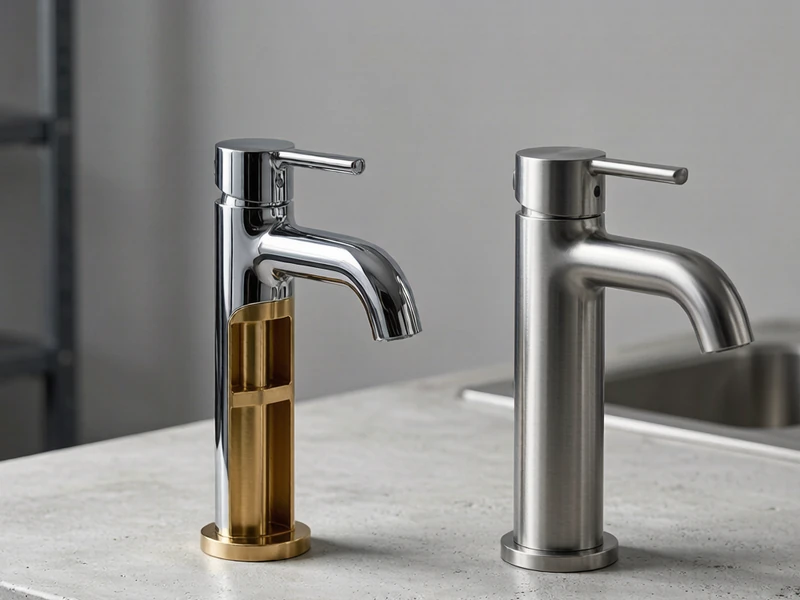
Choosing between brass and stainless steel basin faucets is one of the first cost decisions B2B buyers face when sourcing a new line. The material affects unit price, tooling deposit, lead time, finish options and long-term maintenance. It also shapes which certifications are needed and how the product performs in coastal, healthcare or high-traffic environments. In this guide, FAAO breaks down the real procurement costs behind each option so distributors, wholesalers and project buyers can build a margin model that holds up after installation.
The visible part of a basin faucet, the spout and handle, only tells part of the story. Hidden inside are casting methods, machining time, surface treatment, cartridge compatibility and compliance testing. Each of these adds or removes cost before the container leaves the factory.
For importers and project buyers, the right question is rarely which material is cheaper today. It is which material delivers the lowest total cost over the project lifecycle while matching the market’s expectations for finish, durability and certification. A hotel chain in a coastal city, for example, may recover a higher unit cost for stainless steel simply by avoiding premature plating failure.
Brass remains the dominant material for brass basin faucets because it casts cleanly, machines accurately and accepts a wide range of decorative finishes. Most commercial and residential basin mixers use C36000 or C37700 brass bodies with lead content controlled by local regulations.

Brass is the default choice for residential renovations, hospitality projects and commercial buildings where finish variety matters. It is also easier to source in smaller production runs because gravity dies are cheaper to open than stainless steel forming tools.
Need brass basin faucet samples for your next project?
FAAO produces brass basin mixers in chrome, brushed nickel, matte black and custom PVD finishes with OEM/ODM options.
Stainless steel basin faucets are gaining share in commercial kitchens, healthcare facilities and premium residential projects. The most common grade is 304, with 316 reserved for highly corrosive environments such as coastal hotels or laboratories. FAAO also supplies 304-grade products such as the 304 stainless steel drinking faucet for potable-water applications.

Stainless steel is the safer choice when the specification demands inherent lead-free performance, coastal corrosion resistance or frequent aggressive cleaning. It also appeals to buyers marketing sustainability and longevity.
Sourcing stainless steel faucets for healthcare or coastal projects?
FAAO offers 304 stainless steel faucet options with custom finishes and project-specific packaging.
The table below shows typical China FOB ranges for a standard single-lever basin mixer at modest volume. Actual quotes depend on weight, cartridge grade, finish and certification requirements.
| Cost Factor | Brass Basin Faucet | Stainless Steel Basin Faucet |
|---|---|---|
| Unit FOB China | $8 – $22 | $12 – $30 |
| Tooling / mould | $800 – $2,500 | $1,500 – $4,000 |
| Typical MOQ | 300 – 500 units | 500 – 1,000 units |
| Production lead time | 25 – 35 days | 35 – 50 days |
| Finish range | Chrome, nickel, matte black, gold, PVD, antique | Brushed, polished, PVD limited colours |
| Lead-free status | Requires low-lead alloy / plating control | Inherently lead-free |
| Best for | Design variety, faster turns, lower MOQ | Corrosion resistance, potable water, heavy cleaning |
Three variables shape the real entry cost of a new basin faucet SKU: the mould or tooling deposit, the minimum order quantity and the production lead time. Brass usually wins on all three for the first order because gravity dies are cheaper and faster to cut.
Stainless steel, by contrast, often requires higher tooling investment and longer first-article approval. The payback comes in applications where replacement rates are lower. For buyers testing a new market, brass lets you trial several finishes with less capital tied up. For buyers with a recurring specification, stainless steel can reduce warranty claims in demanding environments.
If you are comparing suppliers, ask each factory to quote the same bill of materials and finish. A cheaper brass quote may hide a lower-grade cartridge or thinner plating, while a higher stainless quote may include a ceramic cartridge rated for 500,000 cycles. For more background on supplier evaluation, see our complete B2B sourcing guide to faucets from China.
Use the calculator below to compare total landed cost and ten-year total cost of ownership for a brass and stainless steel basin faucet order. Adjust quantities, unit prices, tooling and expected replacement costs to match your project.
Brass total landed
$0
Stainless total landed
$0
Brass 10-year TCO
$0
Stainless 10-year TCO
$0
Certification is not a line item on every quote, but it changes the effective cost. Brass faucets exported to North America generally need NSF/ANSI 61 and NSF/ANSI 372 compliance, which means using lead-free brass, controlled plating chemistry and third-party testing. The same faucets bound for Australia or New Zealand need WaterMark certification.
Stainless steel simplifies some of this. Because it is inherently lead-free, testing for lead leaching is usually more straightforward. However, it still requires mechanical performance, flow rate and pressure testing under the same schemes. For a full market-by-market breakdown, see our faucet certifications compared guide.
The decision matrix is simpler than it looks. Choose brass when the priority is design flexibility, lower upfront tooling and faster market testing. Choose stainless steel when the project demands inherent lead-free performance, resistance to aggressive cleaning or long service intervals in corrosive environments.
For hotel developers, the choice often depends on location. A beachfront resort benefits from stainless steel's salt resistance, while an urban boutique hotel may prefer brass for its richer finish palette. Our guide on how to choose basin faucets for hotel bathroom projects walks through the specification steps in more detail.
Brass is usually cheaper at low to medium volumes because gravity die casting and polishing are faster and tooling costs are lower. Stainless steel becomes more competitive when replacement and warranty costs over five to ten years are included.
Both can last ten years or more with quality cartridges. Stainless steel resists corrosion and dezincification better in harsh environments, while brass with quality plating performs well in normal residential and commercial use.
Most manufacturers set MOQs between 300 and 500 units per SKU for brass basin faucets. Custom finishes or new moulds may raise the first-order minimum.
Yes, if they use lead-free brass and meet local standards such as NSF/ANSI 372 in North America or WaterMark in Australia. Always confirm the alloy composition and test reports before importing.
Many distributors stock both. Brass covers the volume residential and hospitality market with more finish options. Stainless steel serves healthcare, food service, coastal and sustainability-focused segments.
Brass and stainless steel each have a clear role in a B2B basin faucet range. Brass offers lower entry cost, faster turns and richer finishes, making it the default for residential, hospitality and commercial projects that value design flexibility. Stainless steel offers inherent corrosion resistance, lead-free performance and lower lifecycle cost in demanding environments such as healthcare, coastal hotels and food-service facilities. Match the material to the project, verify the certification path, and negotiate tooling and MOQ before placing the first order. For a tailored quote, samples or a side-by-side specification review, contact FAAO.
 Optimized by Seraphinite Accelerator
 Telefone:
  E-mail:
  Portuguese
  English
  Spanish
  French
  Russian