

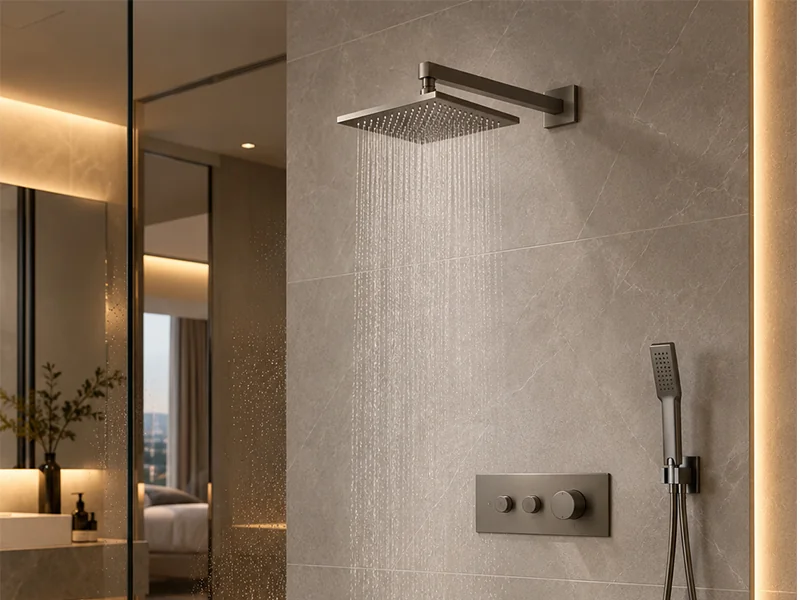
For most hotel bathroom refits, the best concealed shower set is a thermostatic model on a brass rough-in body, paired with a 200–250 mm rain head and a hand shower on a diverter. One SKU then covers anti-scald safety, housekeeping speed and spare-part standardisation.
The catch: a refit is constrained by what is already inside the wall. Cavity depth, water pressure and the condition of the old rough-in decide the answer before your design intent does.
Below are the five decisions that settle it, a spec sheet by hotel tier, and the rough-in checks to run before you raise a purchase order.
Short answer: for a 4-star refit, specify a thermostatic concealed shower set with a brass rough-in body, a 2-function diverter (rain head plus hand shower), a 38 °C preset stop and an EN 248 chrome or PVD finish. For economy rooms and back-of-house showers, a manual single-lever concealed mixer is the cost-effective equivalent. Confirm cavity depth before you order either.
A conjunto de chuveiro oculto puts the valve body inside the wall and leaves only a cover plate, a lever and the shower outlet visible. For a property running a housekeeping schedule, that changes four things at once.
The trade-off is access. Everything that can fail is behind tile, so the rough-in body, the service opening and the cartridge access route have to be right at first fix — which is exactly what the next section is about.
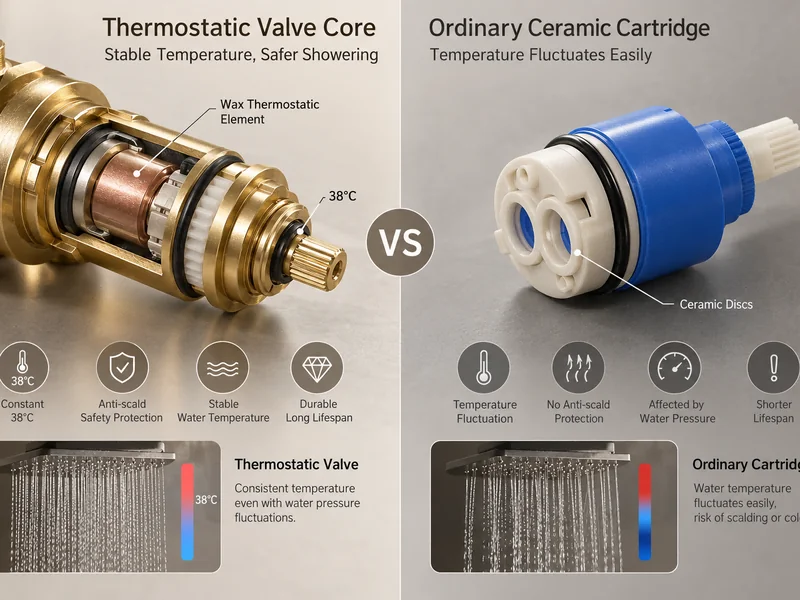
This is the decision that most affects guest safety and your liability position, and it is where the answer to “which type is best” usually lands.
| Tipo | How it works | Anti-scald | Best for | Cost index |
|---|---|---|---|---|
| Thermostatic | A wax or liquid-filled element expands and contracts to hold the set temperature, independent of pressure swings elsewhere in the building | Yes — shuts down if cold supply fails | 4-star and above, family resorts, any property with a buffet-style hot water loop | 1.6–2.2× |
| Pressure-balance | A diaphragm or piston balances hot and cold inlet pressure so the blend ratio stays roughly constant | Partial — corrects pressure, not supply temperature drift | Midscale properties with a stable, centrally controlled hot water temperature | 1.2–1.4× |
| Manual single-lever | A ceramic disc cartridge mixes by lever position only | No | Economy tiers, staff and back-of-house showers, markets where the code does not require it | 1.0× |
A thermostatic element is the one that makes a measurable difference in a hotel, because a guest flushing a toilet in the room next door no longer changes the shower temperature mid-use. If you want the mechanics in more depth, our thermostatic shower valve specification guide for hotel projects covers response time, 38 °C preset stops and TMV scheme requirements.
Where the budget or the plumbing will not support a thermostatic body, a thermostatic shower column is the low-disruption alternative: all the temperature control, none of the wall opening.
In a refit this is the constraint that kills specifications, not the design. Measure from the finished wall face to the back of the cavity before anyone signs a fixture schedule.
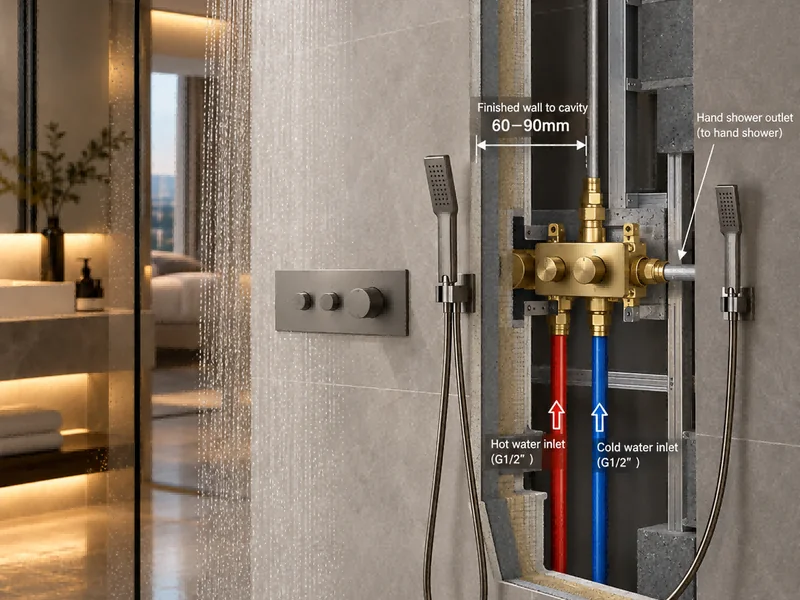
A standard universal wall-mounted concealed shower set body covers most hotel wall build-ups, but slim variants exist for shallow stud partitions — check the depth table in the tool below before you order.
More functions means more to fail, more to descale and a higher unit cost. In practice:
Specify the rain head at 200–250 mm for a standard guest room. Larger heads look impressive in a showroom but drop the perceived pressure at the flow rates most hotels actually run (8–12 L/min at 3 bar).
| Terminar | Typical standard | Housekeeping reality | Use where |
|---|---|---|---|
| Cromo | Electrodeposited Ni-Cr to EN 248, commonly tested to 200 h neutral salt spray | Shows water spots; forgiving of almost any cleaning agent | High-turnover hotels, any market, easiest to match later |
| PVD matte black / gunmetal | PVD coating, materially harder and more abrasion-resistant than plating | Hides water spotting well; needs pH-neutral cleaner, no abrasives | Boutique and design-led properties; confirm your housekeeping products first |
| Brushed nickel / brushed gold | PVD or brushed plating over brass | Best at hiding both spots and fingerprints | Upscale and luxury tiers |
| Matte white | Powder coat or PVD | Marks easily from coloured cleaning cloths | Niche design schemes only |
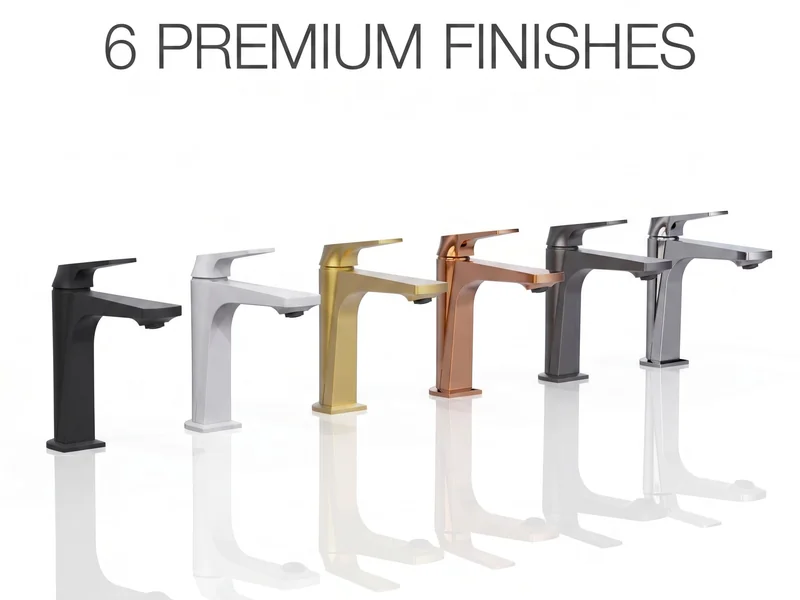
Darker finishes are now a mainstream hotel choice rather than a risk. Our matte black concealed shower set range uses a PVD finish specifically because a plated black in a hard-water, high-occupancy bathroom will not hold up for a full refurbishment cycle.
Ask four questions of any set before it goes on the schedule:
Point four is the one that quietly saves money. If the basin mixer and the concealed shower share a cartridge, your engineering team stocks one part, not four.
Send us your room count, wall build-up and target market. FAAO returns a concealed shower set specification, certification list, sample lead time and a project quotation — usually within two working days.
Use this as a starting schedule, then adjust for your water quality and market certification. FAAO supplies hotel bathroom shower faucets across all four tiers from a single factory, so the finish and cartridge family stay consistent if you mix tiers within one property.
| Tier | Valve | Functions | Rain head | Terminar |
|---|---|---|---|---|
| Economy / limited service | Manual single-lever, brass body | 1-function | 200 mm | Chrome, EN 248 |
| Midscale (3–4 star) | Thermostatic or pressure-balance | 2-function | 200–220 mm | Cromo |
| Upscale (4–5 star) | Thermostatic, 38 °C preset stop | 2-function | 220–250 mm | Chrome or PVD matte black |
| Luxury / suites | Thermostatic, high flow | 2–3 function | 250 mm+ | Brushed gold / brushed nickel PVD |
Run these three checks before the purchase order goes out. The tables are static, so you can print this section and hand it to your site team.
Measure from the finished wall face to the back of the cavity at three rooms per floor, not one.
| Measured depth | What to specify |
|---|---|
| Under 45 mm | Concealed is not viable. Use a shower column instead. |
| 45–60 mm | Slim rough-in body, 1 or 2 function |
| 60–90 mm | Standard universal body (most hotel walls) |
| 90–120 mm | Standard body plus extension kit |
Rule of thumb: cartridges at 5% of rooms, hoses and hand showers at 10%, gaskets at 20%.
| Rooms | Spare cartridges | Spare hose + hand shower | Spare cover plates |
|---|---|---|---|
| 50 | 3 | 5 | 2 |
| 100 | 5 | 10 | 3 |
| 200 | 10 | 20 | 5 |
| 300 | 15 | 30 | 8 |
Not sure whether a standard or slim rough-in body fits your build-up? Our technical team will confirm compatibility from a photo and a dimension, and quote both retrofit trim and full-replacement options side by side.
Certification is a gate, not a nice-to-have — a container without the right mark does not clear. Confirm the target list before tooling or finish sampling.
| Market | What is usually required |
|---|---|
| EU / UK | EN 817 (mechanical mixers), EN 1111 (thermostatic mixers), EN 248 (coatings), WRAS approval, TMV2 or TMV3 scheme for care-type settings |
| Australia / New Zealand | WaterMark certification to AS/NZS 3718 plus a WELS water-efficiency rating |
| North America | ASME A112.18.1 / CSA B125.1, NSF/ANSI 61 and 372 for lead content, cUPC where specified |
| Middle East | SASO or G-mark, frequently requested alongside EN or WRAS evidence |
| França | ACS attestation de conformité sanitaire |
A thermostatic concealed set carries a meaningful premium over a manual concealed mixer at factory-gate, typically in the range shown in the cost index above. Against that, weigh the two costs that actually show up in a hotel P&L: guest complaints about temperature swings, and the liability position if a guest is scalded. In most refits the premium is recovered within the first complaint-free season.
Practical numbers for planning:
We ship finish samples and a cutaway rough-in body so your team can test cleaning agents, check the lever action and confirm the depth on a mock-up wall. OEM and ODM branding is available on the cover plate and packaging.
Thermostatic, in almost every guest-facing application. It holds the set temperature when pressure changes elsewhere in the building, which is the single most common cause of shower complaints and scald incidents in hotels. A manual single-lever set is defensible in economy rooms, staff showers and markets where the code does not require anti-scald protection, and it costs roughly half the premium of a thermostatic body.
Only if it is the same brand and series as the new trim, and only if it passes a pressure test. Trim kits are not interchangeable between manufacturers, so any unknown body should be treated as a full replacement. If the existing body is a known model still in production, a trim-only swap avoids opening the wall and can cut the per-room installation cost substantially.
A standard universal rough-in body needs 60–90 mm from the finished wall face to the back of the cavity. Slim bodies work down to about 45 mm, and extension kits take standard bodies out to roughly 120 mm. Below 45 mm, concealed is usually not viable and an exposed shower column is the better answer. Always measure several rooms, because stud partitions and wet-wall build-ups vary across a floor plate.
Chrome to EN 248 remains the most forgiving choice for high-turnover housekeeping, because it tolerates almost any cleaning agent and is the easiest to match years later. PVD finishes, including matte black and brushed gold, are harder and more abrasion-resistant, but they need pH-neutral cleaners and no abrasive pads. In hard-water regions, brushed finishes hide spotting better than polished ones.
Five cartridges per 100 rooms is a working rule of thumb, alongside ten spare hoses or hand showers and about twenty gasket sets. Hold more if your water is hard or if incoming pressure exceeds 5 bar, as both shorten cartridge life. Standardising on one cartridge across the basin and shower fittings in a room reduces the number of distinct spares your engineering team has to carry.
Specify one concealed shower set SKU for the whole property, not one per room type. A thermostatic body in brass, with two functions and an EN 248 chrome or PVD finish, keeps housekeeping training to a single routine, cuts your spare inventory to one cartridge type, and gives guests a shower they rate well.
Confirm cavity depth and static pressure first, then lock the finish and the certification list against your target market. Send FAAO your room count and wall build-up and we will return a matched specification, sample lead time and a refit quotation.
 Optimized by Seraphinite Accelerator
 Telefone:
  E-mail:
  Portuguese
  English
  Spanish
  French
  Russian