Bienvenido a FAAO Sanitary Ware Co., Ltd.
 Teléfono: +86 13868315922
  Correo electrónico: [email protected]
Teléfono: +86 13868315922 Correo electrónico: [email protected]  Teléfono: +86 13868315922 Correo electrónico: [email protected]

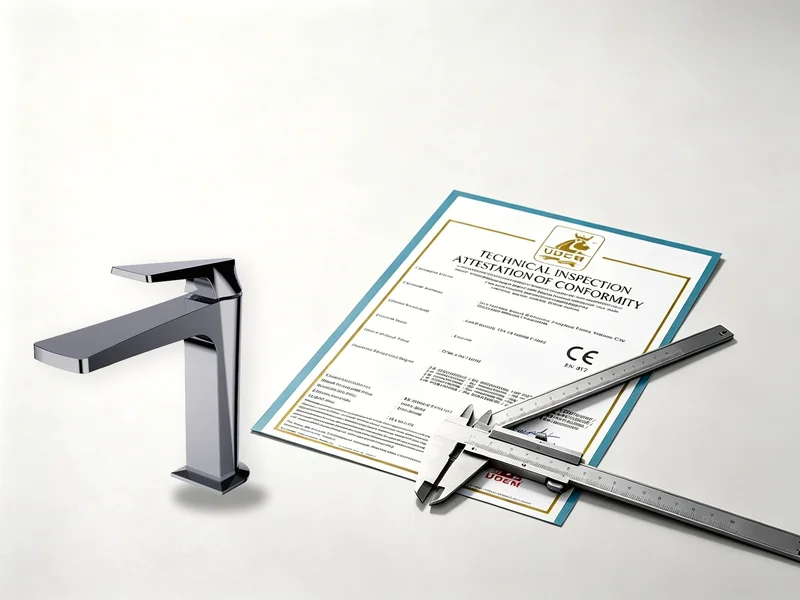
Sourcing tapware for the European Union is no longer only a question of price, finish and lead time. Since the General Product Safety Regulation (EU) 2023/988 began applying in December 2024, and with EU-wide hygiene rules for drinking-water contact materials arriving at the end of 2026, importers carry documented legal responsibility for every tap they place on the market. This guide explains what CE certification really covers on a faucet, where it stops, which extra approvals each member state expects, and how to confirm a supplier’s paperwork is genuine before you release a deposit.
CE (Conformité Européenne) is not a quality award and it is not issued by a government body. It is the manufacturer’s legal declaration that a product meets the applicable EU health, safety and environmental protection requirements. For sanitary tapware, that declaration is made under the Construction Products Regulation (EU) No 305/2011 (CPR) and is expressed in a document called the Declaration of Performance (DoP).
The practical consequence for buyers is simple: the CE logo stamped on a box means very little on its own. The DoP behind it, and the test reports behind the DoP, are what customs officers, market surveillance authorities and your own retail customers will ask for.
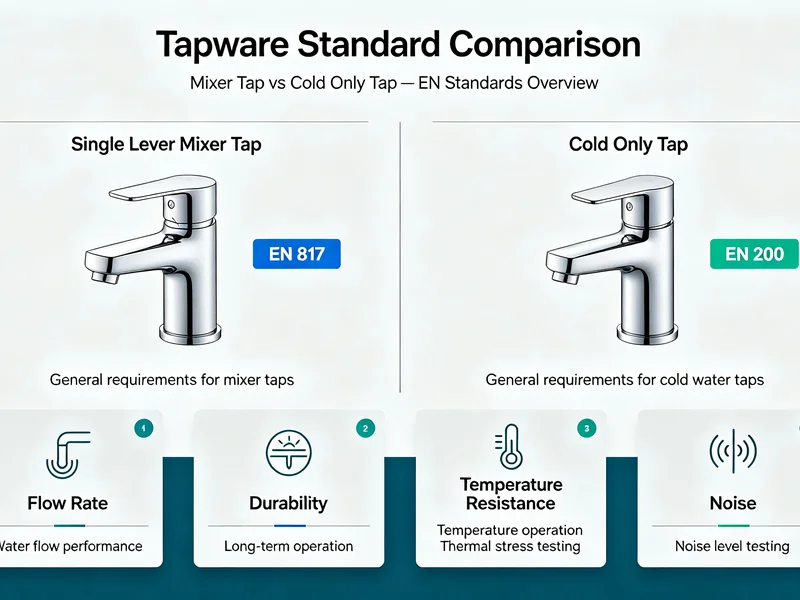
Which harmonised standard applies depends on the product type, not on how the supplier describes its catalogue:
| Standard | Applies to | Main performance checks |
| EN 817 | Mechanical mixing valves (single-lever and two-handle mixers), PN 10 | Flow rate, temperature control, mechanical endurance, pressure and temperature resistance, acoustics |
| EN 200 | Single taps and combination taps (type 1 and type 2) for water supply systems | Dimensional and tightness requirements, flow characteristics, mechanical strength, endurance cycling |
| EN 1111 / EN 1287 | Thermostatic mixing valves and low-pressure mechanical mixing valves | Temperature stability, anti-scald shut-off, pressure fluctuation behaviour |
| EN 248 | Electrodeposited coatings (chrome, nickel, PVD) | Coating thickness, adhesion, corrosion and thermal shock resistance |
If a supplier quotes “CE” without naming the standard, the product type and the assessment system, treat it as an incomplete answer. A basin mixer is assessed against EN 817; a plain commercial kitchen mixer with a single inlet follows a different route; and a thermostatic bar valve belongs to EN 1111, which is why thermostatic shower valves and bath packages are usually documented model by model.
A compliant Declaration of Performance for tapware should state, at minimum:
Two checks take less than five minutes and catch most problems. First, the model code on the DoP must match the SKU on your proforma invoice — a family certificate covering “all basin mixers” is not a valid declaration for the specific model you are importing. Second, the notified body number, when one is claimed, should be searchable in the European Commission’s NANDO database.
The most expensive mistake importers make is treating CE as a single gate. In practice, EU market access for tapware is three separate layers, and CE only covers the first.
This is the layer described above. It answers the question: is the tap mechanically safe, durable, and fit for its declared use? It does not assess whether the materials are hygienically suitable for drinking water.
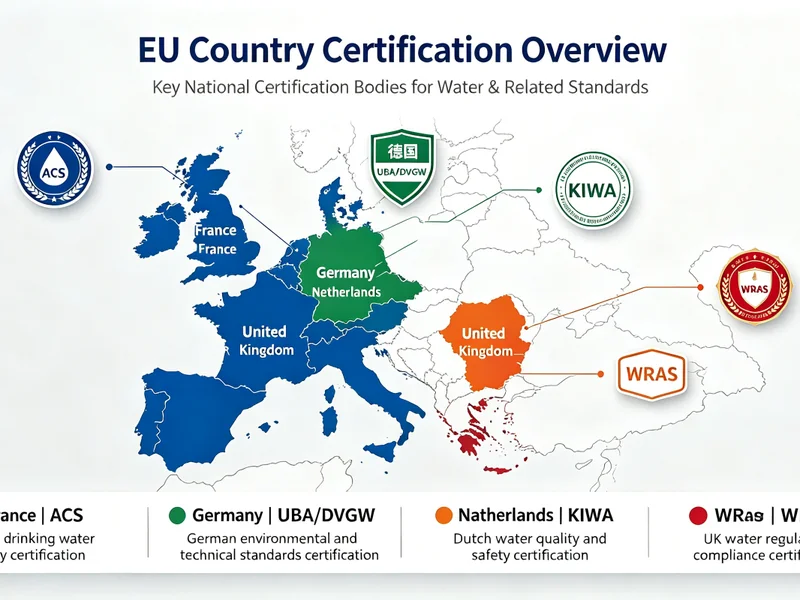
Every EU member state has historically run its own scheme for materials that touch potable water. These are additive to CE, not alternatives to it.
| Market | Approval commonly required | What it tests | Planning impact |
| Francia | ACS (Attestation de Conformité Sanitaire) | Migration of metals and organics from every wetted component | Mandatory in practice; no CE substitute |
| Germany | UBA (KTW-BWGL) evaluation criteria, often with DVGW certification | Positive-list compliance for metals and elastomers, migration testing | Required by most wholesalers and installers |
| Netherlands, Belgium | KIWA / BRL-K mark | Water quality, material hygiene, installation compatibility | Frequent tender requirement |
| Nordics, Poland, Spain | National schemes layered on CE; often type-approval via local distributor | Varies; noise class and water efficiency increasingly specified | Confirm per destination before tooling |
| Reino Unido | WRAS approval (plus UKCA, post-Brexit) | Water fittings regulations compliance | CE alone is not accepted |
The recast Drinking Water Directive moves the EU from national patchwork toward a single European framework. Under the delegated acts adopted in 2024, European positive lists and EU-level minimum hygiene requirements define which starting substances, alloys, elastomers and coatings may be used in products that contact drinking water. The practical dates importers should plan around are:
Because the implementing details continue to be refined, confirm the current version of the positive lists with your notified body or a specialist laboratory before finalising a specification. For importers, the takeaway is strategic: a supplier that can already show 4MS-aligned material documentation saves you a re-engineering cycle in 2027. The same logic applies to finish selection — a re-plating change on an established basin mixer programme can invalidate both coating and migration testing, so lock the plating specification before certification starts.
Building an EU-Ready Tapware Programme?
FAAO supplies CE-marked tapware with model-matched Declarations of Performance, EN 817 / EN 200 test reports and drinking-water documentation for France and Germany. Review the certified ranges and shortlist SKUs for your next container.
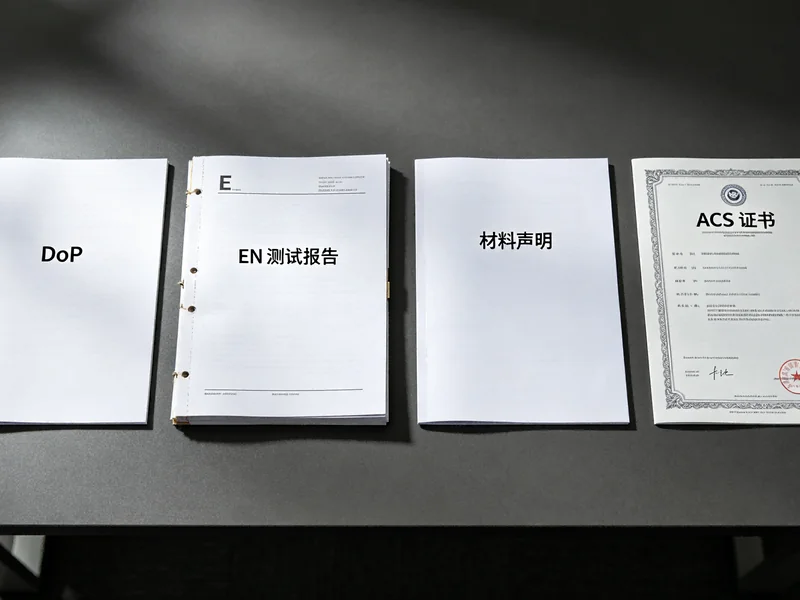
Use this sequence during sampling and again before the first bulk order. Each step is cheap to run and expensive to skip.
| Document | What to check | Red flag |
| Declaration of Performance | Model code, EN standard with year, declared performance values | Generic family name, no performance values |
| EN 817 / EN 200 test report | Accredited lab, sample photos, raw results | Only a summary page, no lab accreditation |
| Material declaration | Brass grade, plating build-up, elastomer compounds | “Brass” with no grade or coating spec |
| Drinking-water certificate | ACS, KTW/UBA or KIWA, validity dates, covered models | Expired, or covers a different model |
| REACH and RoHS statement | References lead, nickel, SVHC screening | Blanket “compliant” with no substance list |
| Traceability and labelling | Batch coding, EU responsible person, importer details | No batch traceability on cartons |
| Item | Typical cost range | Typical lead time |
| CE / CPR documentation package (EN 817 or EN 200) | EUR 1,500 – 5,000 per model family | 4 – 8 weeks |
| National drinking-water approval (ACS / KTW / KIWA) | EUR 3,000 – 9,000 per family | 8 – 16 weeks |
| EU-level hygiene conformity under EU 2020/2184 | Varies by risk group and notified body | Plan 6 – 12 months, including queue time |
Ranges are industry planning figures, not quotations. Costs vary with the number of models submitted, the laboratory and whether the product passes on first submission. Working with a manufacturer that already holds the approvals removes these items from your critical path entirely — which is usually worth more than the saving on a cheaper, uncertified unit.
Need CE and Drinking-Water Documentation in One Place?
Our certified ranges cover CE marking under EN 817 / EN 200 together with ACS attestation for the French market, supported by model-level test reports. Send us your destination market list and we will return a compliance-mapped shortlist.
Yes, where a harmonised standard applies to the product. Sanitary tapware placed on the EU market is declared under the Construction Products Regulation (EU) No 305/2011 against EN 817 for mechanical mixing valves or EN 200 for single and combination taps, and the declaration must be supported by a Declaration of Performance. Member state authorities treat a CE mark without a matching DoP as non-compliant.
EN 817 covers mechanical mixing valves — single-lever and two-handle mixers that blend hot and cold water — with requirements for flow rate, temperature control, endurance and acoustic performance. EN 200 covers single taps and combination taps connected to a water supply system. Thermostatic products are assessed under EN 1111, and low-pressure mechanical mixers under EN 1287. The correct standard is determined by product type, not by supplier preference.
In most cases, yes. CE addresses mechanical safety and performance, not the hygienic suitability of materials that contact drinking water. France requires ACS, Germany expects UBA (KTW-BWGL) alignment and commonly DVGW certification, and the Netherlands asks for KIWA. Treat CE as the entry ticket and the national drinking-water approval as the condition for actually selling in that country.
Three steps. First, confirm the model code on the Declaration of Performance matches your purchase order. Second, look up any notified body number in the European Commission’s NANDO database and check its scope. Third, request the full test report with raw data and the laboratory’s accreditation number, then verify that accreditation with the relevant national body. Certificates alone are easy to reproduce; raw test data is not.
Both, in different ways. The manufacturer is responsible for drawing up the Declaration of Performance and affixing the CE mark correctly. Once the product enters the EU, the importer becomes an economic operator with its own obligations: it must hold the technical documentation, ensure traceability and labelling, keep the DoP available for ten years, and, under the General Product Safety Regulation (EU) 2023/988, ensure that an EU-based responsible person is designated for non-EU manufacturers. In a market surveillance action, the authority will come to you first.
CE certification is the starting line for EU tapware, not the finish line. Importers who treat it as a single checkbox end up with detained containers, failed project inspections and re-testing costs that dwarf any unit-price saving. Ask for the model-matched Declaration of Performance, verify the EN 817 or EN 200 test data behind it, and map the drinking-water approvals your destination markets demand before you sign. Do that, and CE becomes a competitive asset instead of a compliance risk.
 Optimized by Seraphinite Accelerator
 Spanish
  English
  French
  Russian
  Portuguese