Добро пожаловать в компанию FAAO Sanitary Ware Co., Ltd.
 Тел: +86 13868315922
  Электронная почта: экспорт[email protected]
Тел: +86 13868315922 Электронная почта: экспорт[email protected]  Тел: +86 13868315922 Электронная почта: экспорт[email protected]
Sourcing electric towel warmers across borders means more than comparing wattage and finishes. Each target market imposes its own electrical safety, EMC and waterproofing rules, and a single missing certificate can block a container at customs or void a distributor’s insurance. This guide is for B2B buyers who need to specify, quote and ship heated towel rails without compliance surprises.
We cover the marks that matter for Europe, the UK, Australia, New Zealand and North America, plus IP ratings, bathroom zones and material impacts. Use the checklist and market selector to lock the right spec before requesting samples.
Electric towel rails are Class I or Class II electrical appliances installed in damp bathrooms. That combination puts them under the same family of standards as washing machines and dryers, not ordinary plumbing fixtures. In most countries, customs will not release the goods without the correct mark, and local electrical inspectors will refuse connection if the documentation is missing.
The most common B2B mistakes are easy to avoid once you know what to check: accepting an IPX0 rail for a Zone 2 installation, shipping 230 V units to a 120 V market, or assuming that a CE report covers Australia. The sections below break the requirements down by region, voltage and installation zone, with a selector tool at the end to help you lock the right spec before you ask for samples.
The table below shows the four largest export destinations for Chinese electric towel warmers. Use it as a first-pass filter before you shortlist suppliers.
| Market | Required mark | Key standards | Typical voltage | Minimum IP rating |
|---|---|---|---|---|
| European Union | CE + RoHS | EN 60335-1, EN 60335-2-43, EN 55014-1/2 | 220–240 V, 50 Hz | IPX4 |
| Великобритания | UKCA | BS EN 60335-1, BS EN 60335-2-43 | 230 V, 50 Hz | IPX4 |
| Australia / New Zealand | RCM (via SAA) | AS/NZS 60335.1, AS/NZS 60335.2.43 | 230–240 V, 50 Hz | IPX4 (common practice IPX5) |
| United States / Canada | ETL / cETL / UL | UL 499 or UL 2021, CSA C22.2 | 120 V, 60 Hz | No universal IP, but damp-location listing required |
For buyers who need a single compliant range that can be adapted across multiple regions, a full-line электрические полотенцесушители supplier with in-house testing is usually the safest choice. FAAO’s XN-series portfolio covers aluminum, SUS 304, sintered stone and tempered glass finishes, with standard models already built around 220–240 V IPX4 platforms.
IP rating determines where the rail may legally be installed. The first digit is solid-particle protection; the second digit is water protection. For towel rails, the second digit is what matters.
Bathroom zones add another layer. IEC 60364-7-701 divides the bathroom into four zones based on proximity to water sources. A towel rail mounted inside Zone 2 or 3 must carry at least IPX4. Mounting a lower-rated unit in the wrong zone can fail local inspection and expose the importer to liability.
When you request a quote, ask the supplier to confirm the test report number and the accredited lab. Self-declared IP ratings are common in low-cost catalogs but rarely survive a customs audit or an insurance claim.

A 230 V element wired into a 120 V circuit will underheat and disappoint end users. A 120 V element on 230 V will burn out and create a safety hazard. Because towel rails are fixed-connection appliances, the wrong voltage is not a field-fixable problem; it is a product-line decision made at the factory.
| Region | Nominal voltage | Frequency | Wiring notes |
|---|---|---|---|
| EU / UK | 220–240 V | 50 Hz | Hardwired via fused connection unit; some models supplied with UK or EU plug |
| Australia / New Zealand | 230–240 V | 50 Hz | AS/NZS 3112 plug or hardwired isolator; EESS registration required for declared articles |
| North America | 120 V | 60 Hz | NEMA 5-15 plug or hardwired; UL damp-location listing mandatory |
The substrate and finish of a towel warmer influence thermal cycling, corrosion resistance and EMC performance. When you review a supplier’s test reports, make sure the samples tested match the material and finish you intend to order.

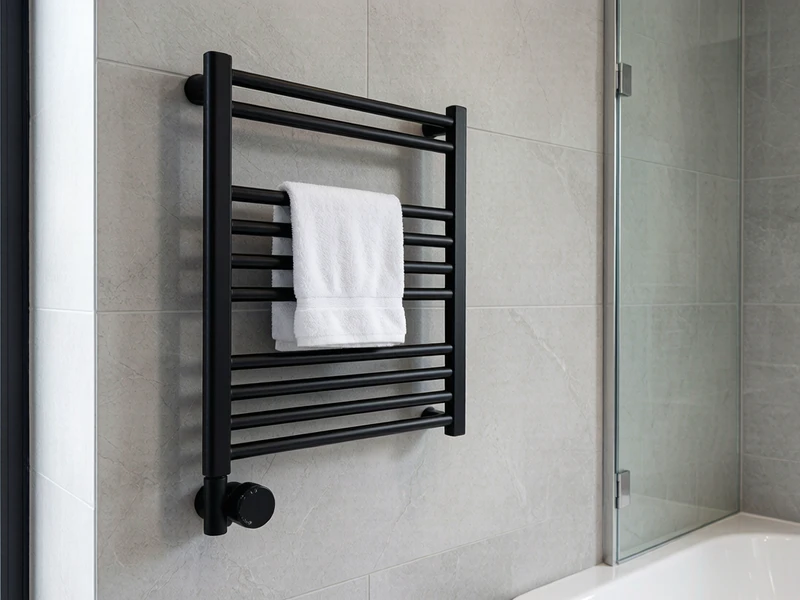
Aluminum heats up quickly and supports anodized, powder-coated and PVD finishes. It is lightweight, which reduces shipping cost per unit. The FAAO aluminum towel warmer XN-616 is rated at 90 W, IPX4 and 500 × 250 × 91 mm, available in black, white and gunmetal gray. Buyers targeting coastal markets should request salt-spray test data beyond the standard EMC and safety reports, because anodized finishes can vary widely in corrosion resistance.
SUS 304 is the default choice for humid and coastal environments. It is heavier than aluminum but offers better long-term corrosion resistance and a premium feel. The FAAO SUS 304 heated towel rail XN-705 runs 60 W at 1205 × 156 × 105 mm and is offered in white, black, brush gold PVD, mirror polish and gunmetal gray. For Australian and New Zealand projects, SUS 304 is often specified explicitly because of coastal salt exposure.
These finishes are becoming popular in high-end hotel and residential projects. The front panel is a decorative surface bonded to an aluminum or steel heating chassis. Because the substrate behind the panel is still a metal rail, the same EMC and safety standards apply, but the surface temperature uniformity test can be harder to pass if the panel acts as a thermal insulator. FAAO’s sintered stone towel warmer range is built around this bonded-chassis approach, with models such as XN-308 already in the catalog.
B2B sourcing tip
If you plan to white-label a heated towel rail, order the test reports in your target finish. A polished stainless report does not automatically cover a PVD black version, because surface coating can change thermal emissivity and EMC shielding.
From a factory standpoint, certification is not a one-time event. Each model, voltage and finish combination must be represented in the certificate. Before you place a trial order, confirm the following:
Typical OEM lead times range from 35 to 55 days after sample approval, depending on whether the voltage or finish is already within the supplier’s existing certificate. Custom finishes or new RAL colors usually add 10–15 days for color-matching and re-testing swatches.
Select your target market below to see the required mark, standards, voltage, IP rating and documentation. This tool is built for quick pre-quote checks before you contact a supplier.
Choose a market above to display the compliance checklist.
Usually not. A 230 V EU model can often be sold in the UK, Middle East and parts of Asia with only paperwork changes, but North America requires a 120 V design review. Australia and New Zealand need SAA/RCM approval even though the voltage matches Europe.
Water ingress during IPX4 testing. Seals around the control box, cable entry gland and joints must be designed for sustained spray, not occasional splashes. Many first samples fail because the gasket compresses under heat-cycling and loses contact.
IPX4 is the legal baseline for EU, UK and AU/NZ bathroom use, but it assumes the rail is installed outside the direct spray path. Rails near open showers or in hotel wet rooms may need IPX5 or a protective partition.
The safety test cost is similar for aluminum and stainless steel, but each finish may require its own sample. Tempered glass and sintered stone front panels can add thermal-mapping and impact tests, which extends lead time by one to two weeks.
For a design that already complies with the standard, lab testing takes two to four weeks. Certificate issuance and database registration add another two to four weeks. New designs or non-standard voltages can take eight to twelve weeks.
At minimum: a valid test report from an accredited lab, the certificate or listing file, a Declaration of Conformity, and a rating-plate drawing. For AU/NZ, also confirm EESS registration and the exact model number on the certificate.
Need a project-specific certificate review?
FAAO supplies aluminum, SUS 304, sintered stone and tempered glass towel warmers with CE/UKCA-ready platforms and supports voltage, finish and branding customization for OEM orders.
Certification is the first filter in B2B towel warmer sourcing. Match the mark to the market, confirm voltage and IP rating for the zone, and check that reports cover model and finish. Get this right, and heated towel rails become a repeatable product line instead of a customs gamble.
About FAAO
Wenzhou FAAO Sanitary Ware Co., Ltd. designs and manufactures faucets, bathroom accessories and electric towel warmers for global brands, retailers and project contractors. With in-house R&D, die-casting, machining, finishing and assembly, FAAO supports OEM/ODM programs from sample to serial production.
Disclaimer: This article is for general B2B guidance only. Always engage a local compliance consultant or notified body to confirm current regulatory requirements before shipment.
 Оптимизировано Серафинит - Акселератор
 Russian
  English
  Spanish
  French
  Portuguese