Добро пожаловать в компанию FAAO Sanitary Ware Co., Ltd.
 Тел: +86 13868315922
  Электронная почта: экспорт[email protected]
Тел: +86 13868315922 Электронная почта: экспорт[email protected]  Тел: +86 13868315922 Электронная почта: экспорт[email protected]

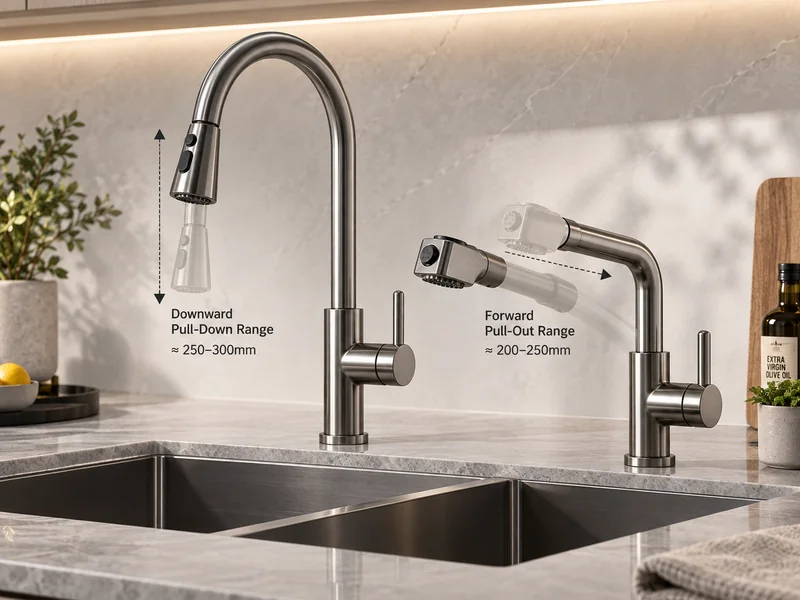
Choosing between a pull-down and a pull-out kitchen faucet looks like a small design decision. For importers, distributors and project buyers, it changes tooling, spare-part inventories, warranty rates and how a whole development gets specified. Get it wrong and the cost shows up as clearance complaints, return requests and a container of the wrong SKU. This guide compares both spray types on the specs that actually affect bulk sourcing: hose travel, spout clearance, cartridge size, flow compliance and MOQ, so procurement teams can lock the right model before the order goes out.
Get a tailored kitchen faucet quote for your project
FAAO supplies pull-down and pull-out kitchen faucets in brass with 30 mm ceramic cartridges and 50 cm braided hoses. Tell us your quantities, finish and certification needs.
Both types use the same three components: a brass body, a ceramic disc cartridge and a flexible hose that disappears back into the spout. The difference is the direction the spray head travels.
A pull-down kitchen faucet has a tall gooseneck spout. The spray head pulls straight down toward the sink basin, and a weight on the hose retracts it. Because the head starts high, you need vertical clearance above it.
A pull-out kitchen faucet has a shorter, lower spout. The spray head pulls forward and out toward the user, in a shallow horizontal arc. It needs clear space in front of the faucet rather than above it, which is why it suits shallow sinks and kitchens with low overhead cabinets.
Both configurations are produced on the same platform in FAAO’s kitchen faucet range, so finish, cartridge and certification options carry across the line.
| Attribute | Pull-Down | Pull-Out |
|---|---|---|
| Spray head travel | Vertical, straight down | Horizontal, forward toward user |
| Typical spout height | 200-300 mm | 100-200 mm |
| Clearance needed | 40-60 mm above the spray head | Minimal overhead, needs front space |
| Best sink match | Deep single bowl, farmhouse, undermount | Shallow or double bowl, low-clearance layouts |
| Filling tall pots | Easier, high arc clears the pot rim | Possible but tighter |
| Indicative FOB band | Mid to upper | Lower to mid |
| Typical programmes | Apartments, spec homes, hotel kitchens | Volume retail, e-commerce, entry-level projects |

Pull-down models sell on reach and appearance. The high arc clears stockpots and deep farmhouse basins, and the tall silhouette is what most North American and European buyers now expect in a mid-to-upper kitchen.
From a sourcing angle, three points matter more than the look:
ФААО single-hole pull-down kitchen faucet is built on a brass body with a 30 mm ceramic cartridge, a stainless spout and a G1/2 50 cm flexible hose, which covers the spec most project buyers write into tender documents.
Pull-out models sell on practicality and price. The low spout fits under wall cabinets and inside compact layouts, and the shorter body uses less brass, so the unit price lands lower.
That makes pull-out the default for volume retail, e-commerce private label and entry-level housing where the buyer is scoring on landed cost per unit.
The trade-offs to write into the spec:
For buyers who want the lower price point without dropping the spray function, a pull-out kitchen tap with a brass body and zinc handle keeps the material story intact while holding the FOB down.

The spray direction gets the attention, but these five items decide your landed cost, your warranty exposure and whether the shipment clears customs.

Not sure which spray type your market wants?
Compare pull-down, pull-out and kitchen faucet with sprayer models side by side, then request samples for your own sink and clearance test.
Use the selectors below to match the spray type to your project profile. This is a starting point for specification, not a quotation.
| Item | What to confirm in writing |
|---|---|
| Body and handle material | Brass body, zinc or brass handle, stated copper content |
| Cartridge | 30 mm or 35 mm ceramic disc, brand plus cycle-test report |
| Hose | 50 cm or 60 cm braided stainless, G1/2 connections, pull-test standard |
| Spray head | One-function or two-function, and whether it is separately replaceable |
| Retraction | Gravity weight or magnetic dock, plus return-cycle test |
| Заканчивать | Chrome, matte black or black-and-gold, with salt-spray test hours |
| Flow rate | 1.5-1.8 gpm for North America, 6-8 L/min for most EU programmes |
| Certification | WaterMark, CE, ACS or NSF matched to the destination market |
| MOQ and lead time | 200 pcs per model, plus sample approval and production slots |
| Spare parts and packaging | Spray heads and hoses at 1-2% of volume, drop-tested carton |
Ready to spec your next kitchen faucet order?
Send us your sink layout, target flow rate and certification market. FAAO will match a pull-down or pull-out model, quote against your quantity and arrange samples for testing.
Neither type fails first because of the spray direction. Service life is set by the cartridge and the hose retraction system. Specify a 30 mm or 35 mm ceramic cartridge with a documented cycle test, and check how the hose returns, because failed retraction generates more warranty claims than any other fault.
Usually not. Both are commonly supplied as single-hole kitchen mixers, and a deck plate can cover the unused holes on a three-hole sink. The important variable is spout height and clearance, not the hole count, so confirm the layout rather than the drilling.
A 50 cm braided stainless hose with G1/2 connections is the practical standard for most residential and hospitality sinks. If the basin is wider than about 800 mm, or the spec includes deep farmhouse bowls, step up to 60 cm so the head still reaches the corners.
In most catalogues, yes. The shorter body uses less brass and the head is often a simpler one or two-function unit, so the unit price and carton volume both come in below a comparable pull-down. That is why pull-out dominates entry-level housing and private-label retail programmes.
Yes, and many developers do. A common pattern is pull-down in show units and premium stacks where buyers see the kitchen first, and pull-out in the standard units where the saving is multiplied across hundreds of rooms. Keep the cartridge and finish identical so your spare-part inventory stays simple.
There is no universal winner between pull-down and pull-out. Pull-down wins where deep basins, tall stockpots and a premium look drive the specification. Pull-out wins where landed cost, low overhead clearance and compact layouts decide it. Score your project on clearance, sink depth, certification market and spare-part strategy, then lock the spec in writing before samples are made. For bulk pricing, custom finishes or project deliveries, contact the FAAO team for a quote built around your specification and timeline.
 Оптимизировано Серафинит - Акселератор
 Russian
  English
  Spanish
  French
  Portuguese