


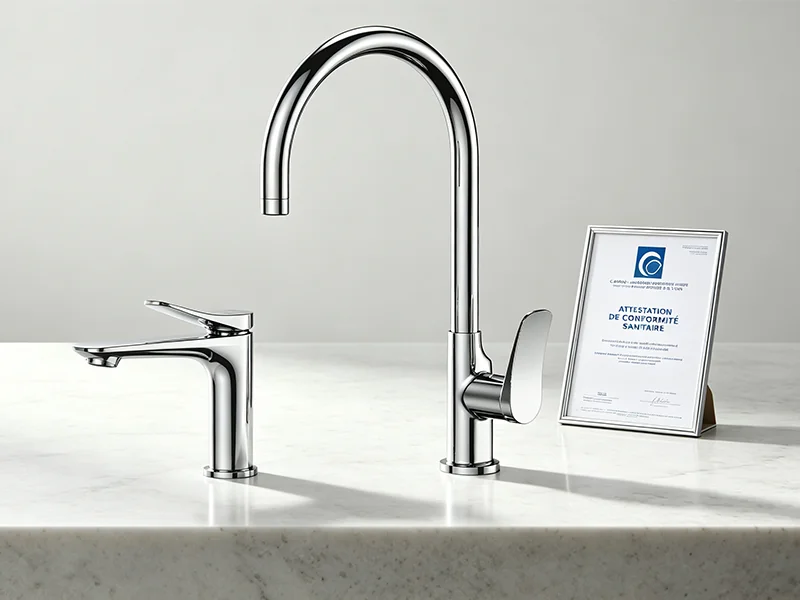
France is one of Europe’s largest sanitary ware markets — and one of the hardest to enter legally. Any product that touches drinking water needs ACS (Attestation de Conformité Sanitaire), a French health-ministry certificate that CE marking does not replace. For importers, distributors and project buyers, the real question is not whether you need ACS, but whether your supplier’s certificate is genuine, current, and covers the exact model you are buying. This guide explains what ACS covers, how the 4MS brass rule and the upcoming EU drinking water reform change your sourcing plan, and how to verify a manufacturer in five steps.
ACS stands for Attestation de Conformité Sanitaire — a sanitary conformity attestation governed by the French Public Health Code and the ministerial order of 29 May 1997 (as amended). It is administered by the French Ministry of Health and issued by accredited laboratories such as CSTB, CARSO and LNE.
ACS asks one question only: does this product change the water? Testing covers three areas:
A certificate is valid for five years, and covers the assembled product’s wetted components: faucet body, cartridge, flexible hose, rubber seals and surface coatings. Products made entirely from a single metal material can fall outside the ACS scope, but a finished faucet almost never does — cartridges, seals and hoses are non-metallic.
The critical point for buyers: ACS is about public health, not mechanical performance. Flow rate, pressure resistance and endurance sit under CE marking and the EN 817 (mechanical mixers) and EN 200 (single and combination taps) standards. You need both.
Most sourcing disputes in France come from buyers assuming one certificate covers everything. It does not. Here is how the layers fit together.
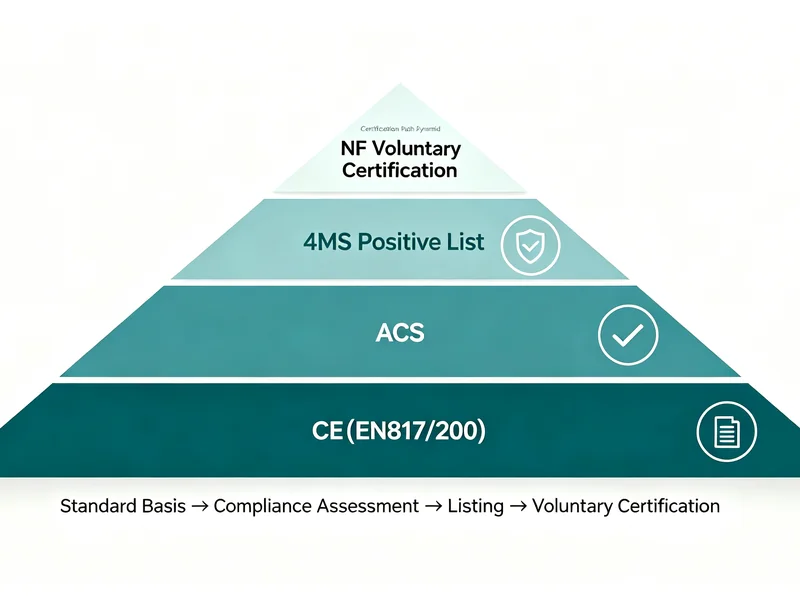
| Layer | What it governs | Status in France |
|---|---|---|
| CE marking EN 817 / EN 200 | Mechanical safety, dimensions, pressure, endurance, flow class | Mandatory EU-wide; requires a Declaration of Performance (DoP) |
| ACS Attestation de Conformité Sanitaire | Drinking water health: migration, sensory, microbial | Mandatory for any product contacting potable water; 5-year validity |
| 4MS positive list Arrêté of 25 June 2020 | Which metallic alloys may be used at all | Applied since 1 January 2021; ACS is not issued for non-listed alloys |
| NF Robinetterie | Voluntary quality mark (durability, finish, water tightness) | Not legally required, but frequently requested by French distributors and specifiers |
The practical takeaway: budget for a layered compliance file, not a single certificate. A supplier that can only produce a CE declaration is not ready for France. A useful next read is our side-by-side breakdown of WaterMark, CE, ACS and NSF certification requirements by market.
Since 1 January 2021, French rules require metallic materials in contact with drinking water to appear on the 4MS positive list — a harmonised list built by France, Germany, the Netherlands and the United Kingdom. If a faucet body is cast from an alloy that is not on the list, no new ACS attestation will be issued, regardless of how well the product performs in migration testing.
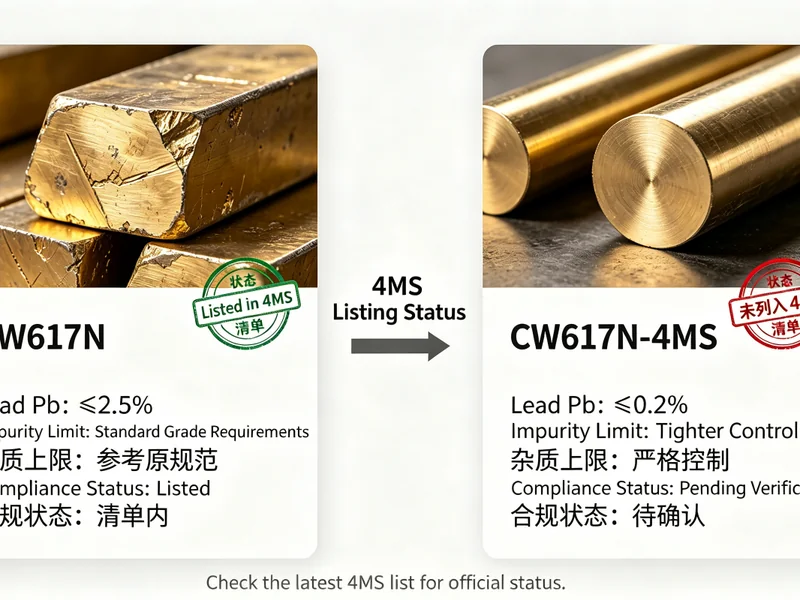
This is where many Chinese-made faucets quietly fail. Standard brass CW617N (CuZn40Pb2) is widely used and perfectly legal in many markets. But the 4MS-listed version — typically designated CW617N-4MS or CW617N-DW — carries tighter chemistry:
| Alloy | Lead content | 4MS status |
|---|---|---|
| CW617N / CuZn40Pb2 | Up to 2.5% by mass | Not listed as standard grade |
| CW617N-4MS / CW617N-DW | Up to 2.2% by mass; each impurity element ≤ 0.02% | Listed — accepted for ACS |
| CW602N | Low-lead grade | Excluded from the 4MS list |
| Stainless steel (graded) | No specific restriction | Generally accepted |
Note the counter-intuitive part: CW602N is a lower-lead alloy than CW617N, yet it is the one excluded from the list. Compliance is about the listed designation, not the raw lead number. When you request a quotation, ask for the exact alloy designation in writing and check it against the certificate.
Certificate fraud in this category is rarely a crude forgery. It is usually a real certificate attached to the wrong product. Use this checklist before you sign a purchase order.
| Step | What to request | Red flag |
|---|---|---|
| 1. Model match | Certificate listing your exact model code | Certificate for FA-100 while you are buying FA-100B |
| 2. Independent verification | Certificate number, issuing lab, query via CSTB / CARSO / LNE portal | Supplier insists the PDF is sufficient |
| 3. Dates and scope | Issue date, 5-year expiry, list of covered wetted components | Certificate expiring within your delivery window |
| 4. Alloy declaration | 4MS-listed alloy designation on both certificate and quotation | Generic “brass” with no grade specified |
| 5. Raw test data | Full migration report with measured values, plus CE DoP | Only a summary page; no measured numbers |
Steps 2 and 5 are the ones that expose fake documentation. A certificate document is easy to edit; quantitative migration results tied to a lab file number are not. For a wider due-diligence framework, see our B2B checklist for auditing a bathroom faucet factory in China.
Not sure your supplier’s ACS file will pass a French inspection?
Send us the model codes you plan to import. We will confirm coverage, expiry dates and 4MS alloy status before you commit to a container.
Compliance gets you to the table. Product fit wins the order. Across French distribution and project channels, demand concentrates in four families:

Finish-wise, chrome still leads French volume. Matte black has real momentum in renovation, brushed nickel and brushed gold stay niche. Ahead of any sourcing trip, it is worth reviewing how standards and buyer preferences differ by region — the French market rewards catalogues that are narrow and compliant rather than broad and generic.
If you are building a France-specific range, start with categories that already carry certification at the model level: our ACS-ready basin faucets and kitchen faucets cover the two highest-volume French segments.
ACS will not disappear tomorrow, but it is living on borrowed time. The recast EU Drinking Water Directive (EU) 2020/2184 introduces harmonised minimum hygiene requirements for materials and products in contact with drinking water, replacing the current patchwork of national approvals.
Under the schedule currently in place:
What should a buyer do with this today? Three things. Keep ACS as your non-negotiable requirement for anything shipping into France now. Ask suppliers whether their bills of materials already align with the EU positive lists, because the reform is material-level, not product-level. And avoid committing to five-year contracts with manufacturers who cannot produce a full material declaration — that gap will surface long before 2032.
FAAO was founded in 2001 in Wenzhou, China, with a fully integrated production chain covering foundry, machining, polishing and assembly. That vertical structure matters for certification: because alloy casting happens in-house, brass grade control and traceability are auditable at source rather than delegated to a subcontractor.
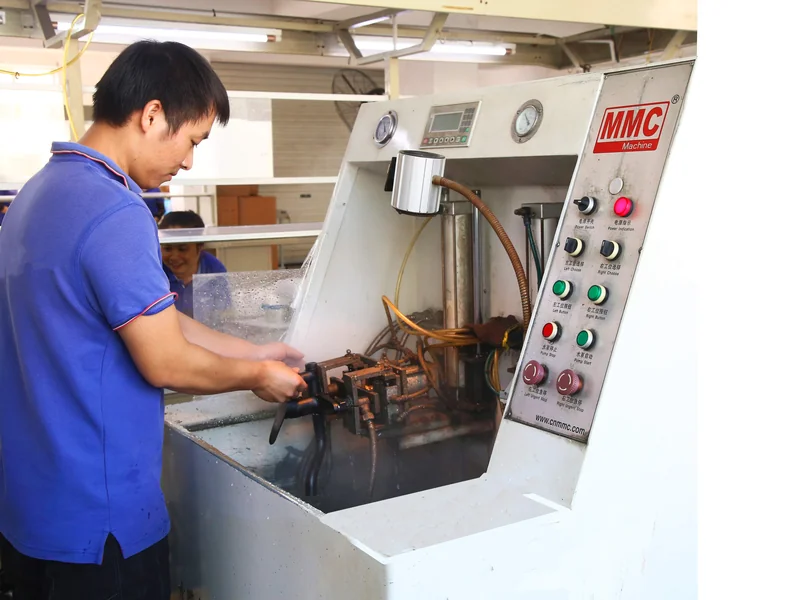
Our compliance file for the French market includes:
Currently 40 faucet models carry ACS certification, spanning basin, kitchen, shower and bathtub applications, with OEM and ODM support so your own brand ships on our certified platforms instead of restarting the certification clock.
Build a France-ready range without re-certifying from zero
Browse 40 ACS certified faucet models, or send us your specification for an OEM quotation with full documentation.
No. CE marking allows a product to circulate in the EU and covers mechanical safety and performance under EN 817 and EN 200. France additionally requires ACS for anything that contacts drinking water, because ACS addresses a different risk — whether materials contaminate the water. Both are mandatory; holding only one leaves you non-compliant.
An ACS attestation is valid for five years from issue, with no annual surveillance fee during that period. It must be renewed before expiry, and it must be re-declared earlier if the product’s composition, wetted components or supplier changes. Products manufactured after a lapsed certificate are not covered, so align renewal dates with your production schedule rather than your purchase date.
Yes, and it is the most cost-efficient route for distributors. When a manufacturer holds ACS on a given platform, branded versions produced on that same platform — same body, cartridge, seals and hose — are covered by the original attestation. What invalidates coverage is a change of wetted components, so lock the specification before you change finishes or swap in a cheaper cartridge.
They need to be covered, though not necessarily by separate certificates. ACS is assessed on the assembled product’s wetted parts, so a certified faucet’s listed scope should name its cartridge, hose and seals. The risk appears when hoses or angle valves are sourced separately and bundled at destination — those items frequently arrive with no ACS coverage at all and become the reason a shipment is rejected.
Not immediately. Directive (EU) 2020/2184 introduces harmonised EU hygiene requirements that are scheduled to apply to new products from the end of 2026, with existing national attestations such as ACS continuing to be accepted through a transition period running to the end of 2032. Practically, ACS remains your market-access document for France today, while the EU system is what you should be preparing your bills of materials for.
ACS compliance is not a formality — it is the gate that decides whether your French customers can legally install your products. Get three things right and most problems disappear: confirm the certificate covers your exact model, confirm the alloy is on the 4MS positive list, and confirm the test report exists with measured values. Do that, and France becomes a repeatable market rather than a one-off gamble. With the EU’s harmonised rules arriving at the end of 2026, the suppliers worth partnering with now are the ones already documenting materials at component level.
Ready to source ACS certified sanitary ware for France?
FAAO supplies 40 ACS certified models with full documentation packs and OEM/ODM support. Tell us your target models and volumes for a quotation within one business day.
 Optimized by Seraphinite Accelerator
 Tel:
Tel:  E-mail:
  English
  Spanish
  French
  Russian
  Portuguese