

China remains the largest source of bathroom hardware in the world, but the category has changed. Factory clusters now compete on certification, plating quality and engineering support rather than price alone — and a shortlist built on 2020 assumptions will send you to the wrong supplier.
This guide profiles ten bathroom hardware manufacturers in China that matter in 2026: where they are based, what they make best and which buyer each one suits. It also sets out the checks to run before you place a purchase order, so you can filter any name on your list in the same way.
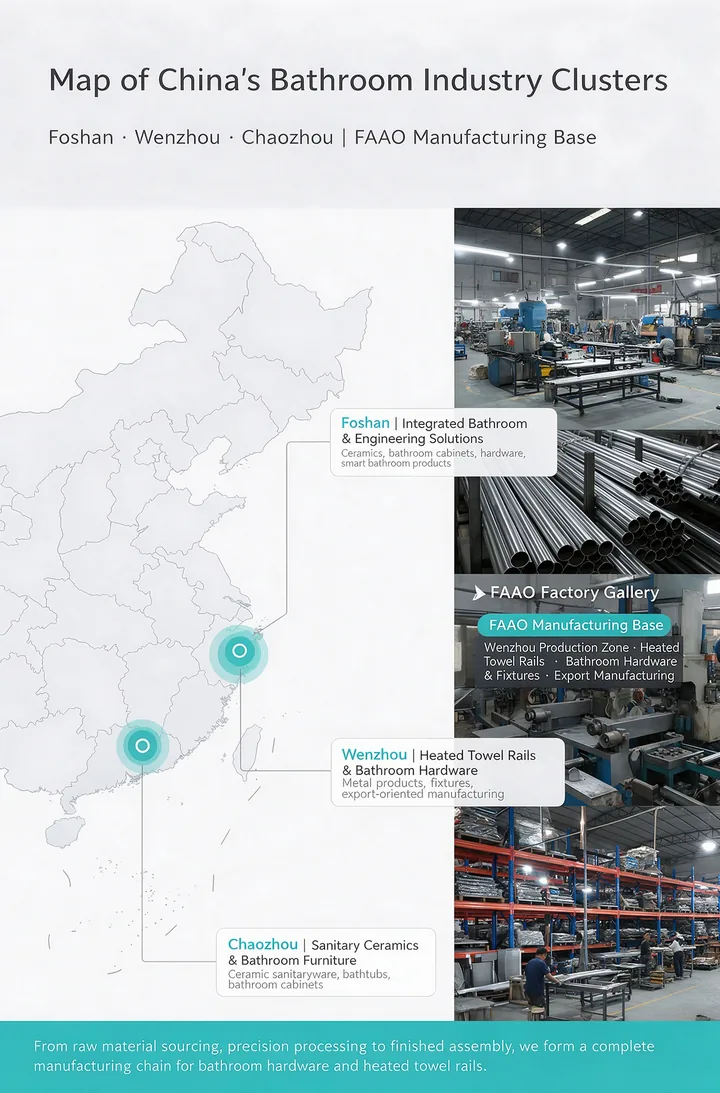
Quick answer: China’s bathroom hardware production is concentrated in four clusters — Wenzhou (Zhejiang) for hardware, fittings and electric heated towel rails; Foshan (Guangdong) for integrated bathroom and ceramics; Kaiping and Heshan (Guangdong) for brass faucet bodies; and Xiamen (Fujian) for ODM faucet engineering. For a mixed container of hardware, towel rails and faucets, a Wenzhou-based manufacturer usually shortens the supply chain the most.
Bathroom hardware is a process-heavy category. A single towel bar moves through tube bending or casting, polishing, electroplating, salt-spray testing, assembly and retail packaging — and in China those steps typically sit within a two-hour drive of each other. That density is why a Chinese factory can quote a new finish in days and still test to a 480-hour acid salt spray standard.
The clusters are also specialised, and knowing which one you are buying from tells you more than a price list does:
Since 2023 the competitive line has moved from unit price to documentation. Buyers now ask for model-level CE, ACS or Watermark reports, cartridge brand declarations and plating thickness data before they ask for a discount. The manufacturers below are the ones that answer those questions quickly, which is the practical definition of a reliable supplier.
We assessed candidates on five criteria that map to how B2B orders actually fail:
The profiles combine publicly available company information with the criteria we apply in our own factory benchmarking. Details such as MOQ, certification scope and product range change over time — confirm them directly with each supplier before you commit.
The ten companies below cover the full spread of the category, from full-range bathroom groups to hardware specialists. They are listed by scale and category breadth, not by ranking.
JOMOO is one of China’s largest full-category bathroom brands, with a range that runs from basin faucets and showers to smart toilets and accessories. Its strength is breadth: a distributor can build an entire bathroom programme from one catalogue, backed by a national service network and heavy investment in tooling.
For export buyers the trade-off is scale. Brand-driven pricing and long approval cycles make JOMOO a better fit for volume retail programmes than for custom hardware. Buyers benchmarking it usually start with basin faucets, where cartridge choice and finish quality are easiest to compare side by side.
Best for: distributors and project buyers who want one brand across a full bathroom range.
ARROW built its position on ceramics and expanded into faucets, showers and smart bathroom products. The group is publicly listed and operates one of the broadest retail networks in China, which gives it strong matching between ceramic bodies and metal fittings.
That matching matters in projects: a hotel refurbishment that specifies ARROW sanitary ware will usually get consistent colour and finish across the bathroom. The company’s shower faucets and thermostatic ranges are the usual entry point for commercial buyers.
Best for: contractors and distributors specifying coordinated bathroom packages.
HEGII focuses on sanitary ceramics and smart bathroom products, with a growing metal range covering showers, faucets and accessories. It is one of the brands that pushed smart toilets into mainstream Chinese retail, and that consumer-facing work shows in finish consistency and packaging standards.
For B2B buyers, HEGII is strongest where the order mixes ceramics with metal fittings and the end customer expects a recognisable brand. Custom hardware development is possible but is not the core offer.
Best for: retail chains and distributors building a branded bathroom assortment.
Huayi sits in Kaiping, the brass faucet cluster of Guangdong, and has exported since the 1990s. Its core competence is copper-alloy casting, machining and multi-layer plating — the unglamorous work that decides whether a faucet still looks new after two years in a hard-water market.
The company runs OEM and ODM programmes for European and Middle Eastern importers, and is comfortable with EN 817 and EN 1111 test requirements. If your range depends on brass bodies and a specific finish, this is the type of factory to benchmark against.
Best for: importers needing brass faucet programmes with EU documentation.
SOLUX is an engineering-led ODM business rather than a catalogue brand. It designs and manufactures showers, faucets and kitchen systems for global retailers, and holds a large patent portfolio — useful when you need a differentiated product rather than a copy of a copy.
The trade-off is that SOLUX works best with buyers who bring a brief, a target price and a volume forecast. Small, mixed hardware orders are not its sweet spot.
Best for: brands and retailers commissioning proprietary designs.
LOTA has supplied faucets and bathroom hardware to North American and European brands for decades, which shows in its documentation discipline: cUPC and NSF paperwork, consistent cartridge sourcing and packaging that survives a 30-day ocean leg.
Its range leans toward faucets and fittings rather than decorative accessories, and the factory is used to brand-owner audits. For a first order from a new Chinese supplier, that audit readiness removes a lot of risk.
Best for: buyers who need US-market compliance experience and audit-ready processes.
AVONFLOW is one of the few Chinese manufacturers that built its export business almost entirely on electric heated towel rails. The category looks simple and is not: heating element reliability, IP rating, thermostat behaviour and EN 60335 compliance decide whether a container sells or comes back.
The company supplies UK, German and Nordic distributors, and its range covers stainless steel, aluminium and tempered-glass models. Buyers comparing suppliers should compare electric heated towel rails at the same wattage and IP rating, not at the same price.
Best for: European distributors and hotel projects sourcing towel warmers.
HUIDA is a sanitary ceramics manufacturer first, with a metal range that supports complete bathroom orders. Its advantage is ceramic capacity and cost control at volume; hardware is a supporting category rather than the core.
That makes HUIDA a sensible partner when the container is mostly toilets and basins and you need matching faucets and accessories to fill it — provided you accept a narrower hardware catalogue.
Best for: sanitary ware importers adding hardware to ceramic orders.
SSWW works across bathroom furniture, ceramics, showers and metal fittings, with an export network covering Europe, the Middle East and Southeast Asia. Its bathroom cabinet programmes are the usual entry point, and hardware is specified to match.
For buyers assembling a retail assortment rather than a single category, SSWW offers coordinated design at a mid-market price point. Deep hardware customisation is better sourced from a specialist.
Best for: mid-market retailers assembling coordinated bathroom collections.
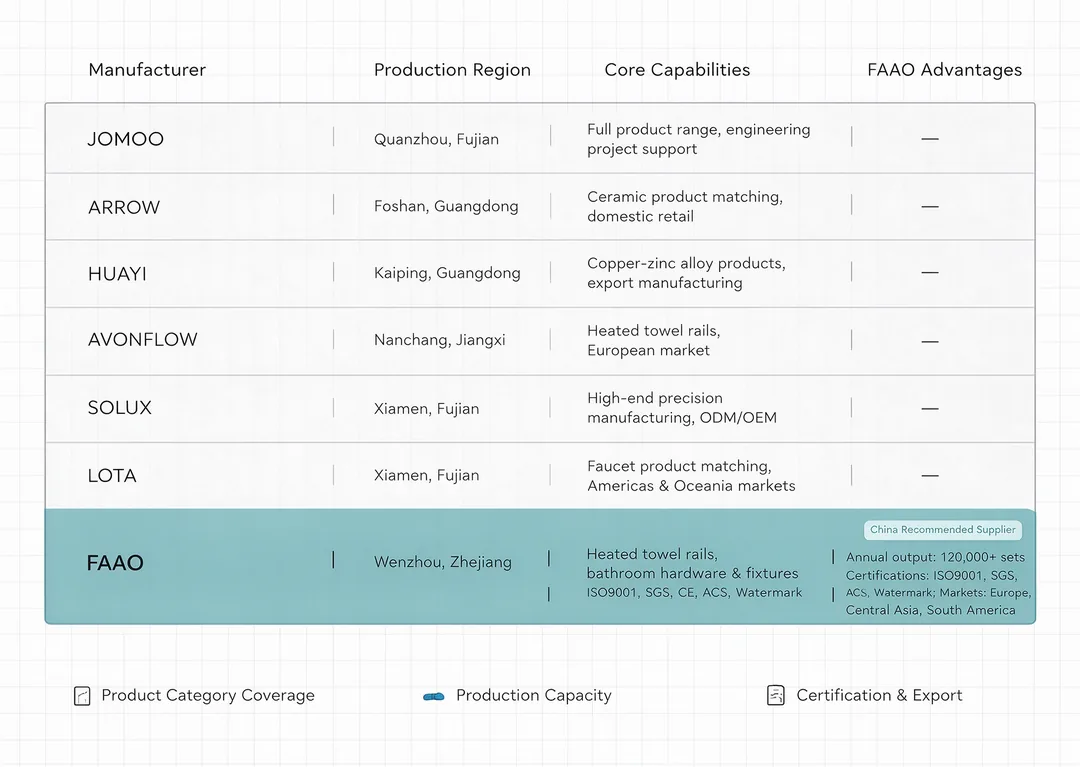
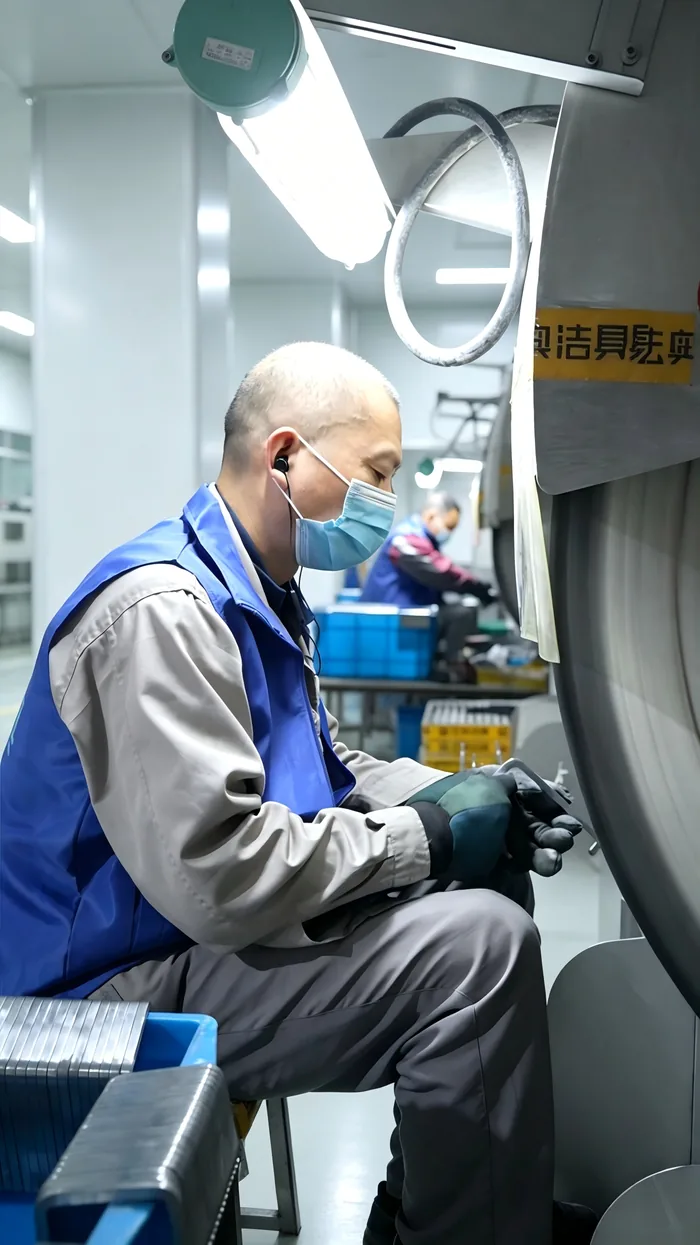
FAAO has manufactured bathroom hardware in Wenzhou since 2001, from a 20,000 m² plant that covers machining, polishing, plating, assembly and testing. The range is deliberately hardware-first: towel bars, rings and shelves, robe hooks, paper holders and soap dispensers, plus electric heated towel rails and faucets.
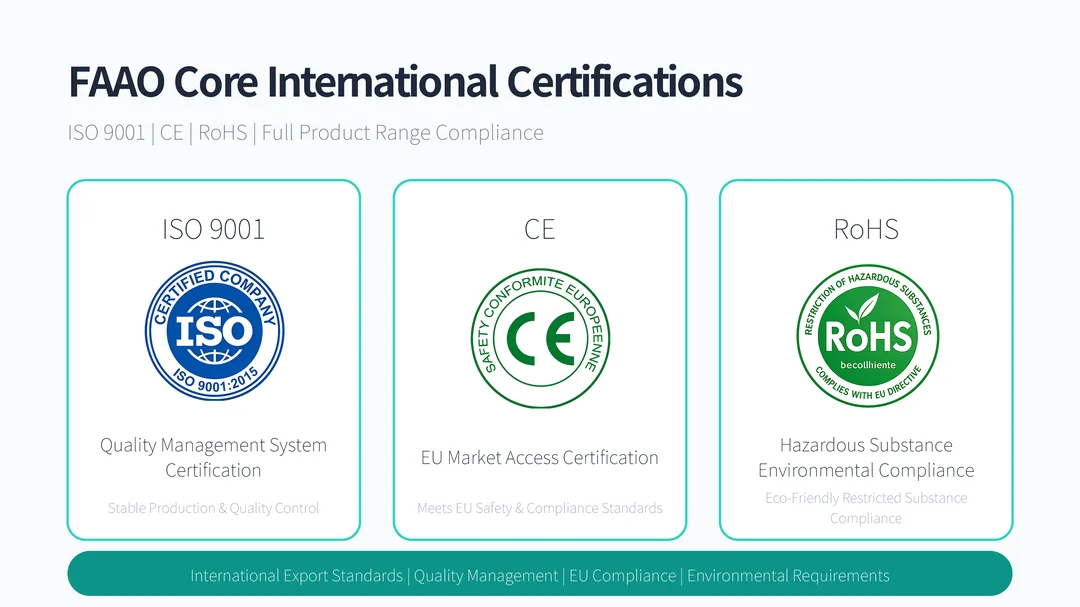
That mix is the point. A distributor can build one mixed container of bathroom accessories, towel warmers and faucets without splitting the order across three factories and three inspection schedules. Certification covers ISO 9001, SGS, CE, ACS and Watermark; the company holds 200+ patents and exports to 80+ countries, with annual output above 500,000 faucets and 120,000+ heated towel rail sets.
Best for: mid-size distributors and hotel projects consolidating hardware, towel rails and faucets.
Use this table to shortlist by category fit before you request quotations. MOQ, lead time and certification scope should still be confirmed supplier by supplier.
| # | Manufacturer | Base | Core strength | Best for |
|---|---|---|---|---|
| 1 | JOMOO | Quanzhou, Fujian | Full-category bathroom range | Branded retail programmes |
| 2 | ARROW | Foshan, Guangdong | Ceramics plus coordinated metal | Project packages |
| 3 | HEGII | Foshan, Guangdong | Smart bathroom and ceramics | Branded retail assortments |
| 4 | Huayi | Kaiping, Guangdong | Brass casting and plating | EU-documented faucet programmes |
| 5 | SOLUX | Xiamen, Fujian | ODM engineering and IP | Proprietary designs |
| 6 | LOTA | Xiamen, Fujian | US-market OEM faucets | Audit-ready first orders |
| 7 | AVONFLOW | Nanchang, Jiangxi | Electric heated towel rails | UK and EU towel warmer distribution |
| 8 | HUIDA | Tangshan, Hebei | Sanitary ceramics at volume | Ceramic-led containers |
| 9 | SSWW | Foshan, Guangdong | Bathroom furniture and ceramics | Mid-market collections |
| 10 | FAAO | Wenzhou, Zhejiang | Hardware, towel rails and faucets | Mixed containers, hotel projects |
Need a shortlist you can actually audit?
FAAO has manufactured bathroom hardware in Wenzhou since 2001, with ISO 9001, SGS, CE, ACS and Watermark certification and exports to more than 80 countries. Send your item list and we will return a spec-matched quote with MOQ, lead time and test reports.
The difference between a good supplier and an expensive lesson is usually documentation. Our own factory audits start with the paperwork below; the full factory audit checklist covers the document side in more detail.
Ask for the certificate in the factory’s own name, then ask for the test report that matches the exact model, finish and cartridge you are buying. A CE mark on a catalogue page is not evidence. For finishes, request a 480-hour acid salt spray (ASS) report; for faucets, confirm EN 817 or ASME A112.18.1 performance data; for towel rails, EN 60335 and the IP rating. Certificates are often issued for one variant and quietly applied to a whole range — the model number on the report is the only thing that settles it.
MOQ is usually quoted per SKU and per finish, not per order — a 500-piece MOQ can become 2,000 once you ask for four colours. Confirm whether the MOQ applies to the item or the finish, what the sample lead time is (typically 7–15 days) and what production lead time follows (30–45 days for hardware, longer for plated finishes in peak season). If tooling is involved, state who owns the mould and what happens to it if you switch suppliers.
Clarify whether your supplier is doing OEM (your brand on their design), ODM (their design, your brand) or custom development, because IP ownership and price structure differ. Packaging is where margin quietly disappears: ask for a drop test, confirm carton marking and barcode placement, and check whether retail-ready packaging is included or charged separately.
Agree the AQL level before production, not after. Most hardware buyers work to AQL 1.5–2.5 for major defects and 4.0 for minor, with 100% functional testing and a sample check on finish. Third-party inspection is worth the fee on a first order; on repeat orders, ask for the factory’s own inspection report and salt-spray batch data.
Factory Vetting Checklist
Ten checks to complete before you release a deposit. Print this page or save it as a PDF for your buying team.
Planning a mixed container?
Towel bars, robe hooks, heated towel rails and faucets can ship together from one Wenzhou plant. Share your target FOB, market and certification route, and our engineers will confirm which SKUs qualify.
1. Buying on unit price alone. Plating thickness is invisible in a photo and decisive in a bathroom. A 5–8 micron layer and a 15 micron layer can look identical on arrival and behave very differently after 18 months of cleaning chemicals. Ask for the specification, then compare price.
2. Mixing finishes across suppliers. “Brushed nickel” is not one colour. Two factories will deliver two shades, and the mismatch only appears when the items are installed side by side in the same bathroom. Order all visible hardware in a set from one supplier, or approve physical samples from each.
3. Ignoring the cartridge and valve standard. A faucet that passes a factory test can still fail on site if the cartridge is not rated for the local water pressure or the flow rate does not meet regional rules. State the standard in the PO — EN 817, ASME A112.18.1 or the relevant local code.
4. Skipping pre-shipment inspection. The cheapest insurance in this category is a third-party inspection before the container leaves. Without it, you discover short shipments, wrong finishes and missing accessories after you have paid the balance.
By revenue and range, the largest are full-category bathroom groups such as JOMOO, ARROW, HEGII and HUIDA. For hardware specifically — towel bars, hooks, dispensers and heated towel rails — the specialist manufacturers in Wenzhou, Kaiping and Xiamen are often more relevant to B2B buyers, because they accept mixed orders and custom finishes that large brand groups prefer not to handle.
It depends on the item. Wenzhou (Zhejiang) is the practical base for bathroom accessories and electric heated towel rails; Kaiping and Heshan (Guangdong) for brass faucet bodies; Foshan for integrated bathroom and ceramics; Xiamen for ODM faucet engineering. If your order mixes categories, a Wenzhou or Foshan supplier will usually consolidate better than a single-category specialist.
At minimum ISO 9001 in the factory’s own name. Then market-specific approvals: CE for the EU, ACS for France, Watermark for Australia and New Zealand, cUPC and NSF for the United States and Canada. For finishes, ask for a 480-hour acid salt spray report; for electric towel rails, EN 60335 and an IP rating. The certificate must match the model number you are ordering.
For stock designs, most Wenzhou hardware factories quote 200–500 pieces per SKU, and the figure often applies per finish rather than per item. Custom designs with new tooling usually start at 1,000–3,000 pieces. MOQ is negotiable on a first order, especially when you combine several SKUs into one container.
Three steps: check the business licence against the factory address, request model-level test reports rather than catalogue claims, and audit or inspect. A video walk-through is a reasonable first filter; a third-party inspection on the first production run is the cheapest risk control available. The document list in our factory audit checklist is a good place to start.
A shortlist is a starting point, not a decision. The right manufacturer for your programme is the one that can evidence its plating thickness, document its certifications and hold a delivery date across repeat orders — and that is usually clear within two conversations.
Use these ten names to narrow the field, then apply the checklist to the two or three that match your category mix. If your order combines bathroom hardware, heated towel rails and faucets, FAAO’s Wenzhou plant is built for exactly that consolidation.
Get a 2026 price list for your market
Tell us your market, certification route and annual volume. We reply within one business day with a spec sheet, MOQ and indicative FOB pricing.
 Optimized by Seraphinite Accelerator
 Tel:
 E-mail:
 English
 Spanish
 French
 Russian
 Portuguese