


For commercial projects — hotels, residential developments, retail fit-outs, office buildings — the finish on a faucet is no longer just a colour choice. It affects maintenance schedules, total cost of ownership, and whether the product still looks presentable at year five. The matte black vs chrome faucet debate has moved from design blogs to procurement meetings, because both finishes now sit in the same product series at most manufacturers. This guide covers what each finish is at the manufacturing level, where each performs best, and what B2B buyers should verify before signing off on a specification.
A common assumption is that matte black and chrome are “different colours” applied the same way. They are not. The two finishes use different coating processes, and that difference drives most of the performance gap buyers notice in the field.
Chrome plating is a multi-layer electroplating process. The brass body is first plated with copper (for levelling), then nickel (for hardness and corrosion resistance), and finally with a thin layer of chromium on top. The chromium layer is what gives chrome its mirror-bright reflective look. Total coating thickness is typically 25–35 microns. Chrome plating is a mature, well-controlled process that has been used on plumbing fittings for over a century.
Matte black on quality commercial faucets is almost always a PVD (Physical Vapour Deposition) coating. The faucet is first chrome or nickel plated, then a thin titanium-based layer is vapour-deposited on top to create the dark, low-sheen finish. PVD coating thickness is much thinner than chrome — usually 0.5–3 microns — but the bonding is far more uniform and the surface is significantly harder than raw chrome.
A cheaper alternative used by some entry-level products is painted black over chrome. The paint layer is thicker but softer, and tends to chip at edges and high-touch points within months. This is the finish most associated with “the black faucet started peeling after six months.” When you compare matte black vs chrome faucet options, always confirm whether the matte black version is PVD or paint. The performance difference is dramatic.
| Attribute | Chrome Plating | PVD Matte Black | Painted Black (Avoid) |
| Coating process | Multi-layer electroplating | PVD over nickel/chrome | Liquid paint over plating |
| Typical thickness | 25–35 microns | 0.5–3 microns | 15–30 microns |
| Surface hardness | High | Very high (harder than chrome) | Low (soft polymer layer) |
| Typical service life (commercial) | 10+ years | 8–10+ years | 1–3 years before visible wear |
For B2B buyers comparing FAAO matte black bathroom faucets against chrome equivalents, every FAAO matte black model in the line uses PVD over nickel-plated brass. Paint-finish black faucets are not part of the FAAO range — that decision was made specifically because paint finishes do not survive commercial service cycles.
Specifications on a data sheet do not tell you which finish to specify. Project context does. The table below summarises how the two finishes behave across the dimensions that matter to commercial buyers.
| Comparison Factor | Chrome | PVD Matte Black |
| Resistance to water spots | Moderate — spots show clearly on mirror surface | High — non-reflective surface hides mineral deposits |
| Fingerprint visibility | High — every touch shows | Low — diffused surface masks prints |
| Scratch visibility | Low — scratches buff out or blend with polish | Medium — scratches show as shiny line on dark surface |
| Corrosion resistance (coastal/humid) | High | Very high — PVD layer resists salt air |
| Cleaning frequency (hotel guest bath) | Daily wipe recommended | 2–3 times per week sufficient |
| Compatibility with hard water | Moderate — visible limescale | Good — limescale less visible |
| Cost premium | Baseline | Typically 10–20% |
| Stock availability | Always stocked across full range | Stocked on top SKUs; MOQ applies on others |
| Design trend status (2025–2027) | Stable, classic | Strong growth in boutique/luxury segment |
For B2B procurement, the two numbers that matter most are scratch visibility and cleaning frequency. Chrome hides minor scuffs because its reflective surface camouflages tiny marks, while PVD matte black shows any deep scratch as a bright line that cannot be buffed out. On the other hand, chrome requires more frequent cleaning because water spots and fingerprints show immediately, while matte black tolerates longer intervals between wipes.
Finish selection in commercial projects is rarely “the whole building in matte black” or “the whole building in chrome.” Most well-designed projects use both finishes intentionally. Below is the working framework FAAO applies when helping specifiers and procurement teams choose.
| Project Zone | Recommended Finish | Reason |
| Hotel guest bathroom | PVD matte black | Design feature; controlled cleaning; high guest perception value |
| Hotel public restroom | Chrome | Heavy traffic; rapid cleaning turnaround |
| Office public restroom | Chrome | Daily heavy use; minimal cleaning budget |
| Office executive washroom | PVD matte black | Low traffic; strong design statement |
| Hospital / healthcare | Chrome | Strict hygiene cleaning protocols; chemical exposure |
| School / university | Chrome | Budget-driven; abuse-resistant requirement |
| Restaurant kitchen | Chrome | Grease, acid cleaners; high-abrasion wipes |
| Boutique retail / showroom | PVD matte black | Brand-aligned statement; low touch frequency |
| Residential apartment (mid-range) | Chrome | Cost-driven; matches resale expectations |
| Residential apartment (luxury) | PVD matte black | Design-led; differentiates unit from comparables |
| Coastal / high-humidity region | Either (prefer PVD matte black) | PVD offers better salt-air resistance |
If you are specifying across an entire property and want a consistent visual language, the practical rule is: specify chrome in back-of-house and high-traffic zones; specify PVD matte black in front-of-house and design-led zones. This gives you the design impact of matte black where guests see it, without exposing it to the wear patterns that cause finish deterioration.
For a quick visual reference, FAAO’s basin faucet range and kitchen faucet range both offer the same series in chrome and PVD matte black, which makes mixed-finish specification easier across a single project.
Talk to the FAAO Specification Team About Your Project
Use the tool below to filter the comparison table by the factor that matters most to your project. Select a factor to see how chrome and PVD matte black compare on that specific dimension.
Chrome: 25–35 micron multi-layer electroplating retains appearance and corrosion resistance for 10+ years in normal commercial use. Failures typically begin at the chrome-nickel interface after the nickel layer is breached by deep scratches.
PVD Matte Black: Titanium-based PVD layer bonds at the molecular level with the underlying nickel plating. Surface hardness is higher than chrome, so it resists abrasion better. The limitation is that the dark layer shows scratches as bright lines, so finish appearance degrades visually faster than chrome even when the underlying corrosion protection remains intact.
Best choice: Chrome for projects expecting 10+ years of uninterrupted service with minimal finish refresh budget. PVD matte black for projects where the underlying corrosion protection matters more than visible micro-scratch appearance.
Chrome: Mirror surface shows water spots within minutes of use and fingerprints on every touch. Housekeeping typically wipes chrome fixtures daily using a soft cloth and mild soap. Buffing takes longer per fixture because each streak is visible.
PVD Matte Black: Diffused surface masks water spots and fingerprints for 2–3 days under normal use. Housekeeping can wipe every 2–3 days with no visible degradation. Time savings across 200+ fixtures per property add up to meaningful labour cost reduction over a year.
Best choice: PVD matte black for hotel guest bathrooms with housekeeping cost optimisation as a priority. Chrome for areas where daily wipe-down is already part of the housekeeping SOP.
Chrome: Lower upfront unit cost. Higher cleaning labour cost over service life. Replacement parts and cartridges are interchangeable with the full product line. Resale or repurposing value is neutral.
PVD Matte Black: 10–20% higher upfront unit cost. Lower cleaning labour cost. Replacement parts within the same series are interchangeable between finishes. Resale or repurposing value depends on design trend stability — currently trending upward.
Best choice: Run a 5-year total-cost comparison before specifying. In most hospitality projects with 100+ fixtures, the labour savings on PVD matte black offset the upfront premium within 18–24 months.
Chrome: Limescale builds up visibly on mirror surface, requiring weekly descaling with mild acid cleaners. Repeated acidic cleaning gradually dulls the chrome reflective layer over years.
PVD Matte Black: Limescale deposits are present but visually masked by the diffused surface. Acidic cleaners should still be avoided because they can attack the PVD layer if left in contact. Weekly wiping with mild soap is sufficient.
Best choice: PVD matte black for hard-water regions where cleaning frequency is the constraint. Specify a water-softener pre-filter if the project allows it — it extends the life of both finishes.
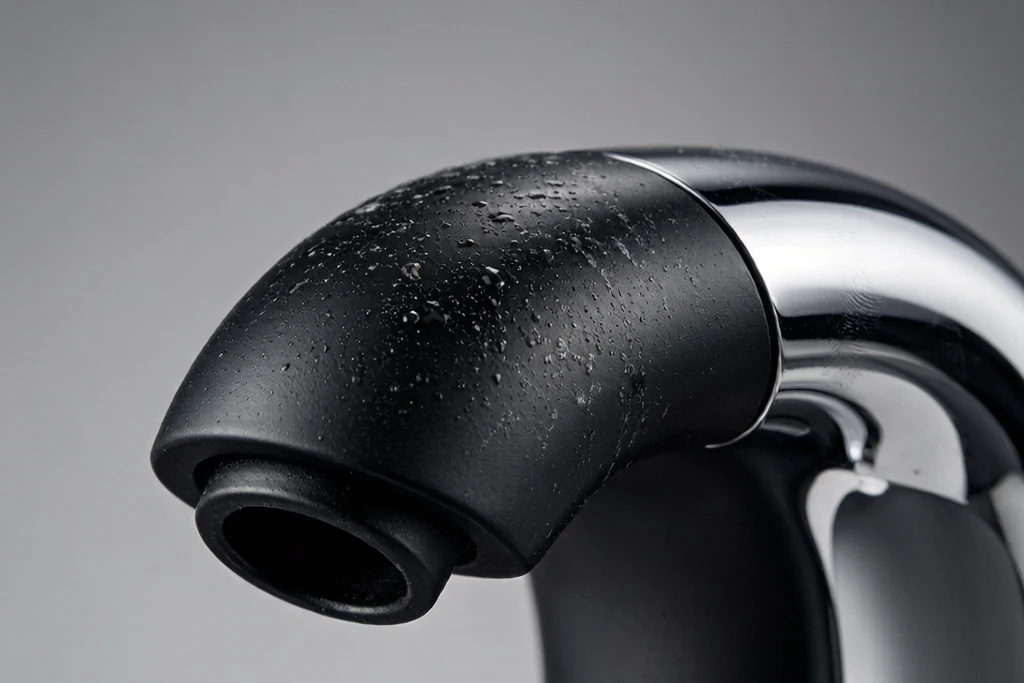
A close-up look at how each finish behaves under real use: water spots show clearly on chrome, while matte black hides them but reveals smudges when handled.
Finish choice is one decision; supply consistency is another. Before placing an order for a commercial project, run through this checklist with the supplier.
1. Confirm the coating process. Ask explicitly: “Is the matte black finish PVD or painted?” If the supplier cannot answer in technical detail, treat it as a red flag. FAAO publishes the coating process on every product specification sheet so buyers can verify independently.
2. Match finish to certification. WaterMark (Australia), CE (Europe), ACS (France), cUPC (North America) certifications are tested on specific material-and-finish combinations. If the certificate covers a chrome model but the order is for the matte black variant, verify the same licence covers that finish. Some suppliers hold separate licences per finish. FAAO’s basin faucet range carries WaterMark across both chrome and PVD matte black variants of each series, which removes this verification step for Australian projects.
3. Get a physical sample. PVD matte black varies significantly between suppliers. Some finishes lean warm-brown, others cool-charcoal. Order a finish sample card or a single unit before committing to a 500-piece order. Colour rendering on a screen is unreliable — physical inspection under the project’s actual lighting is the only reliable check.
4. Specify the cleaning protocol in writing. Avoid acidic cleaners, abrasives, and ammonia-based products on PVD matte black. Include this in the housekeeping SOP and the O&M manual handover. Chrome tolerates a wider range of cleaners but responds best to pH-neutral products.
5. Confirm warranty coverage of the finish. Reputable PVD matte black products carry 5+ years finish warranty against peeling, fading, and chipping. Functional warranty (cartridge, valves, leaks) is separate. Verify both are listed explicitly in the supplier’s terms.
For a deeper look at how FAAO’s matte black and chrome finishes are tested before shipment, see the QC process shown below.

FAAO QC process: PVD coating thickness is measured on every production batch before packing, ensuring finish consistency across a 1,000-piece shipment.
Mistake 1: Assuming “matte black” means the same thing across suppliers. Two faucets both labelled “matte black” can be made by completely different processes with completely different lifespans. The only safe path is to require the supplier to confirm PVD over nickel-plated brass in writing.
Mistake 2: Specifying matte black for high-abuse zones. Public restroom and back-of-house zones see rough handling. PVD matte black shows scratches more visibly than chrome in these conditions, and touch-up is not possible. Keep matte black to controlled-access zones.
Mistake 3: Mixing finishes from different series. If the guest bathroom uses matte black from one series and the public restroom uses chrome from a different series, replacement cartridges and aerators will not be interchangeable. Specify finishes within a single product series wherever possible to keep spare parts management simple.
Mistake 4: Overlooking the design trend horizon. Matte black has been trending in hospitality for several years and remains strong through 2026, but finishes do shift over a 10-year building lifecycle. Chrome is the conservative choice for projects where the specification must hold value across two decades. Matte black is the right choice when the building is being designed for the next 3–5 years of guest expectations.
For more context on how faucet finishes are trending in the wider market, see our analysis of the most popular faucet colour for 2025.
Request FAAO Finish Samples and Certification Documents
PVD matte black is durable enough for controlled-access commercial zones — hotel guest bathrooms, executive washrooms, boutique retail, residential luxury units. It is not recommended for public restrooms, healthcare, schools, or back-of-house areas where the surface will see heavy contact, abrasive cleaning, or acidic chemicals. For these zones, chrome remains the more durable choice.
The PVD layer itself is harder than chrome and resists abrasion at the material level. However, when the PVD layer is breached by a deep scratch, the bright nickel layer underneath shows through as a visible line on the dark surface. In practice, PVD matte black does not scratch more easily than chrome — it shows the scratch differently. Light surface marks blend with the diffused finish; deeper scratches need professional refinishing.
Use a soft microfibre cloth with warm water and a mild pH-neutral soap. Wipe dry after each clean. Avoid acidic cleaners (vinegar, lemon, descalers containing hydrochloric or phosphoric acid), abrasive pads, ammonia, bleach, and solvent-based products. For hard-water areas, dry the surface after use to prevent mineral build-up even though it is less visible than on chrome.
Typically 10–20% higher than the equivalent chrome model, depending on the series and design complexity. Basic single-handle matte black faucets may carry only a 10% premium, while designer pull-down kitchen faucets can be 25% more. The price difference reflects PVD processing costs and lower production volumes compared to chrome. For B2B projects above 100 fixtures, the labour cost saving on cleaning often offsets the upfront premium within 18–24 months.
Within the same product series, cartridges, valves, and aerators are functionally identical between the chrome and matte black variants. They are interchangeable. Across different product series, cartridges are generally not interchangeable regardless of finish, because thread specifications and connection sizes differ. When specifying across a project, keep all faucets within one product series to simplify spare parts management.
The matte black vs chrome faucet choice is not about which finish is better. It is about which fits the project zone, the operating environment, and the maintenance budget. PVD matte black delivers design impact and lower cleaning in controlled zones; chrome delivers proven durability in heavy-use zones. Most projects use both — matte black in front-of-house, chrome in back-of-house — and confirm the matte black is PVD-coated, not painted.
FAAO supplies both finishes across basin, kitchen, and shower ranges with full certification coverage. For samples or a quotation, reach out to the FAAO specification team.
 Optimized by Seraphinite Accelerator
 Tel:
Tel:  E-mail:
  English
  Spanish
  French
  Russian
  Portuguese